
Key Takeaways
- Dental insurance does cover braces — but only if orthodontic benefits are explicitly included in your plan. Coverage is typically 50% of the cost up to a lifetime orthodontic maximum ($1,000–$2,500), not the annual maximum.
- Children under 19 on ACA-compliant plans are guaranteed pediatric orthodontic benefits if the plan includes pediatric dental. Adults need a separate rider or a premium-tier plan that explicitly covers adult orthodontics.
- Most orthodontic benefits require a 12–24 month waiting period before coverage begins. Plan ahead: enrolling in coverage well before treatment starts is the only way to use orthodontic benefits without paying the full cost out of pocket.
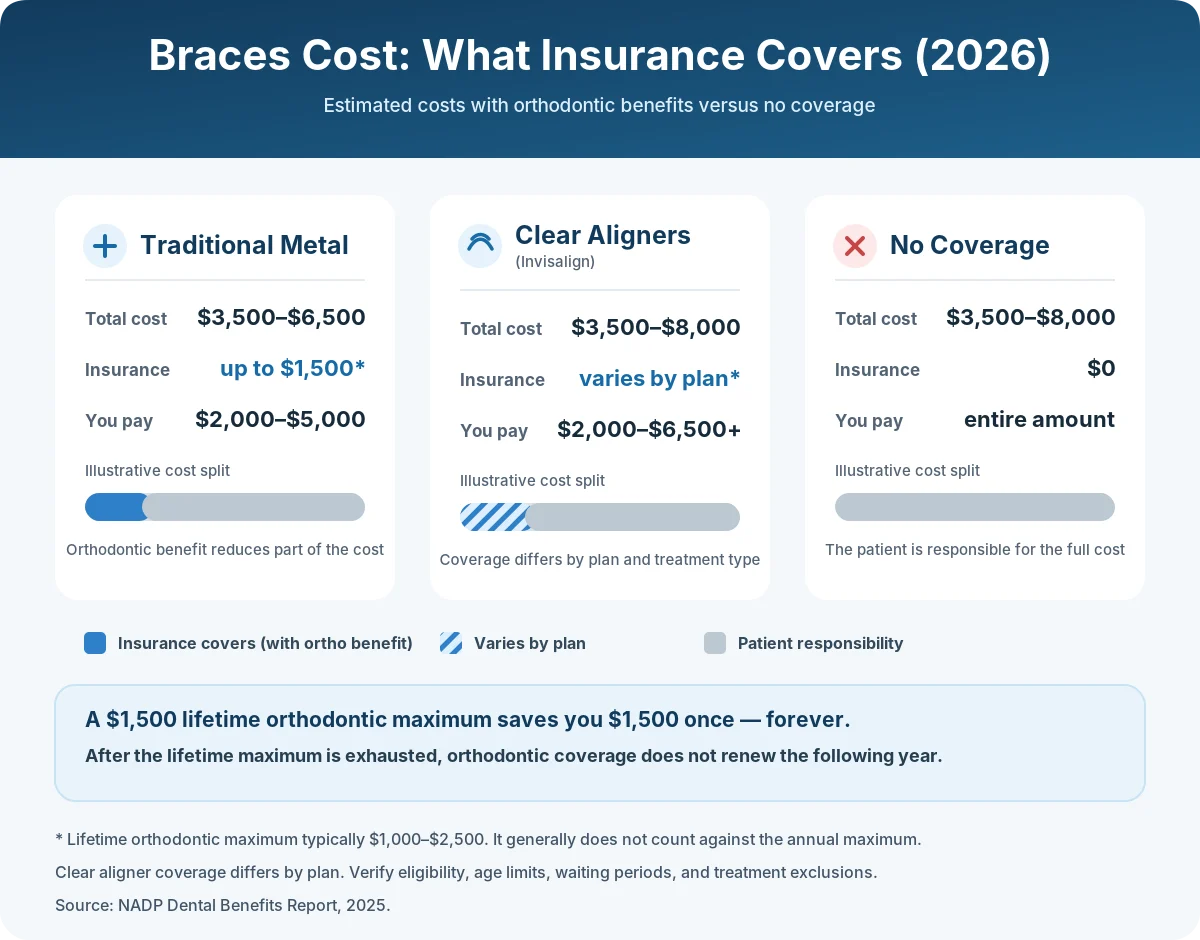
Braces cost between $3,000 and $7,000 for traditional metal braces and $3,000–$8,000 for clear aligners like Invisalign — making orthodontic coverage one of the most valuable benefits a dental plan can offer. But whether your insurance actually covers braces depends on three things: whether orthodontic benefits are included, your age, and how long you have been enrolled.
Does Dental Insurance Cover Braces?
Some dental plans cover braces; many do not. Orthodontic coverage is not a default feature on most individual dental plans — it is either included as an explicit benefit or excluded entirely. Before assuming your plan covers braces, check the plan documents for language that specifically mentions “orthodontic services” or “orthodontia.”
When orthodontic coverage is included, the standard structure is:
- The plan pays 50% of the orthodontist’s allowed charges
- Coverage applies up to a lifetime orthodontic maximum — a separate cap from the annual maximum (typically $1,000–$2,500)
- A waiting period of 12–24 months applies before the benefit is available
Children vs. Adults: How Coverage Differs
Your age is the single biggest factor in orthodontic coverage eligibility.
Children Under 19
Under the Affordable Care Act, all ACA-compliant health plans sold through the marketplace that include pediatric dental must cover pediatric orthodontic services. This means children under 19 are entitled to orthodontic benefits on qualifying plans — typically at 50% of allowed costs up to the pediatric lifetime orthodontic maximum.
However, there is an important nuance: dental coverage on ACA marketplace health plans is split between “pediatric dental embedded in the health plan” and “standalone dental plans.” Standalone dental plans purchased separately are not required to include orthodontic benefits even for children. Always verify the plan documents — “pediatric dental” does not automatically mean “orthodontic coverage.”
Adults (19 and Older)
Adult orthodontic coverage is not required under any federal mandate. For adult coverage, you must find a plan that explicitly includes it — usually through:
- A dental rider added to a base dental plan (adds $10–$25/month)
- A premium-tier individual plan that bundles orthodontic benefits (Spirit Dental, some Cigna and Aetna tiers)
- An employer group plan that includes adult orthodontic benefits (more common in large-employer plans)
Adult orthodontic lifetime maximums tend to be lower than pediatric ones — typically $1,000–$1,500 vs. $1,500–$2,500 for children.
How the Lifetime Orthodontic Maximum Works
Orthodontic coverage uses a lifetime maximum — not an annual maximum. This is a critical distinction. The lifetime maximum is a one-time cap on what the plan will ever pay toward orthodontic treatment for a covered individual. Once used, it does not renew the following year.
For example: a plan with a $1,500 lifetime orthodontic maximum pays up to $1,500 toward your braces — ever. If braces cost $5,000 and the plan covers 50%, that equals $2,500 in potential benefit. But the plan is capped at $1,500, so the plan pays $1,500 and you pay $3,500.
The lifetime maximum does not count against your annual maximum. Your $1,500 in annual dental benefits remains separate from the $1,500 orthodontic lifetime cap.
Waiting Periods for Orthodontic Coverage
Orthodontic waiting periods are longer than other dental service categories. Most individual plans require 12–24 months of continuous enrollment before orthodontic benefits activate. Some plans require 24 months — meaning you must be enrolled for two full years before a single dollar of orthodontic coverage applies.
This waiting period is the most common reason orthodontic insurance disappoints enrollees: buying a plan after a child is already in braces does not trigger coverage retroactively. Enroll well before treatment begins.
Plans with shorter or no waiting periods for orthodontics include Spirit Dental (some tiers), Delta Dental DHMO plans (in some states), and select employer group plans. These typically cost more or require joining through an employer.
Does Insurance Cover Invisalign and Clear Aligners?
Clear aligner coverage depends entirely on the plan language. Most orthodontic benefits are written as covering “orthodontic services” or “comprehensive orthodontic treatment” — and clear aligners qualify under this language on the majority of plans that include orthodontic benefits.
However, some older plan documents specifically list “braces” or “fixed appliances” and may require a plan amendment or rider to cover removable clear aligner systems. When in doubt, call your insurance company and ask specifically whether your policy covers “clear aligner systems such as Invisalign” by name before beginning treatment.
The lifetime maximum applies equally to traditional braces and clear aligners — the plan does not distinguish between treatment types for the purpose of the cap.
Best Dental Plans for Braces Coverage in 2026
If orthodontic coverage is your priority, these plan types tend to offer the strongest benefits:
- Spirit Dental Platinum / Ultra — includes orthodontic coverage with shorter waiting periods than most individual plans. Available nationwide.
- Delta Dental DHMO — in states where available, Delta Dental DHMO plans often include pediatric and sometimes adult orthodontic benefits with copay structures rather than coinsurance.
- Cigna Dental 1500 and Dental 5000 — includes orthodontic benefits on premium tiers with lifetime maximums up to $2,500.
- Aetna Vital Savings + Dental — combines a discount program with insurance and includes orthodontic benefits on qualifying tiers.
- Employer group dental — the most consistent source of adult orthodontic coverage, often with shorter waiting periods and higher lifetime maximums than individual plans.
Frequently Asked Questions
Does dental insurance cover braces for adults?
Adult orthodontic coverage is not standard — you need a plan that explicitly includes it. Most individual dental plans exclude adult orthodontics unless you add an orthodontic rider or choose a premium tier that bundles the benefit. Expect to pay $10–$25 more per month for a plan with adult orthodontic benefits, and verify the lifetime maximum before enrolling.
What is a lifetime orthodontic maximum?
A lifetime orthodontic maximum is the total amount your dental plan will ever pay toward orthodontic treatment for one covered person. It is separate from the annual maximum and does not renew each year. Most individual plans set this at $1,000–$2,500. Once the lifetime maximum is exhausted, the plan pays nothing further toward orthodontics for that individual, regardless of how many years they remain enrolled.
How much does insurance actually save on braces?
On a $5,000 set of braces with a plan that covers 50% up to a $1,500 lifetime maximum, the plan saves you exactly $1,500. Out of pocket you pay $3,500. On a $3,500 case, the plan covers $1,500 (the cap hits before 50% of $3,500 is reached), saving you the same $1,500. The savings are fixed at the lifetime maximum regardless of the total treatment cost.
Does dental insurance cover retainers after braces?
Retainers are often covered under the orthodontic benefit, but typically only as part of the original orthodontic treatment — not as a separate replacement item. If you lose or break a retainer years after completing treatment, coverage depends on whether your lifetime orthodontic maximum is still available and whether your plan covers replacement appliances. Many plans do not cover retainer replacements.
Can I use dental insurance if braces have already started?
Not for treatment already in progress. Insurance covers orthodontic services initiated after the waiting period ends and while coverage is active. If you enroll in a plan with a 12-month waiting period and braces placement occurred before the waiting period expired, that treatment is not covered. Some plans prorate coverage for treatment that began before enrollment — verify with your specific carrier.
Related guides: Dental insurance for braces: best plans and coverage compared — How dental waiting periods work — Average dental insurance cost in 2026 — What does dental insurance cover?
This article is for informational purposes only and does not constitute dental or financial advice. Coverage details vary by plan. Always verify specific coverage with your insurer before scheduling treatment.
Part of the Dental Insurance FAQs. Also read: is dental insurance worth it? — what is a dental deductible? — average dental insurance cost.
Have more coverage questions? See our dental insurance FAQ hub for answers to the most common ones.