The best dental insurance plan isn't one specific policy — it's whichever one fits your situation, health history, and budget. A senior on Medicare needs something entirely different from a freelancer between jobs, and someone facing a $5,000 implant bill has different priorities than a family trying to keep four people's teeth clean.
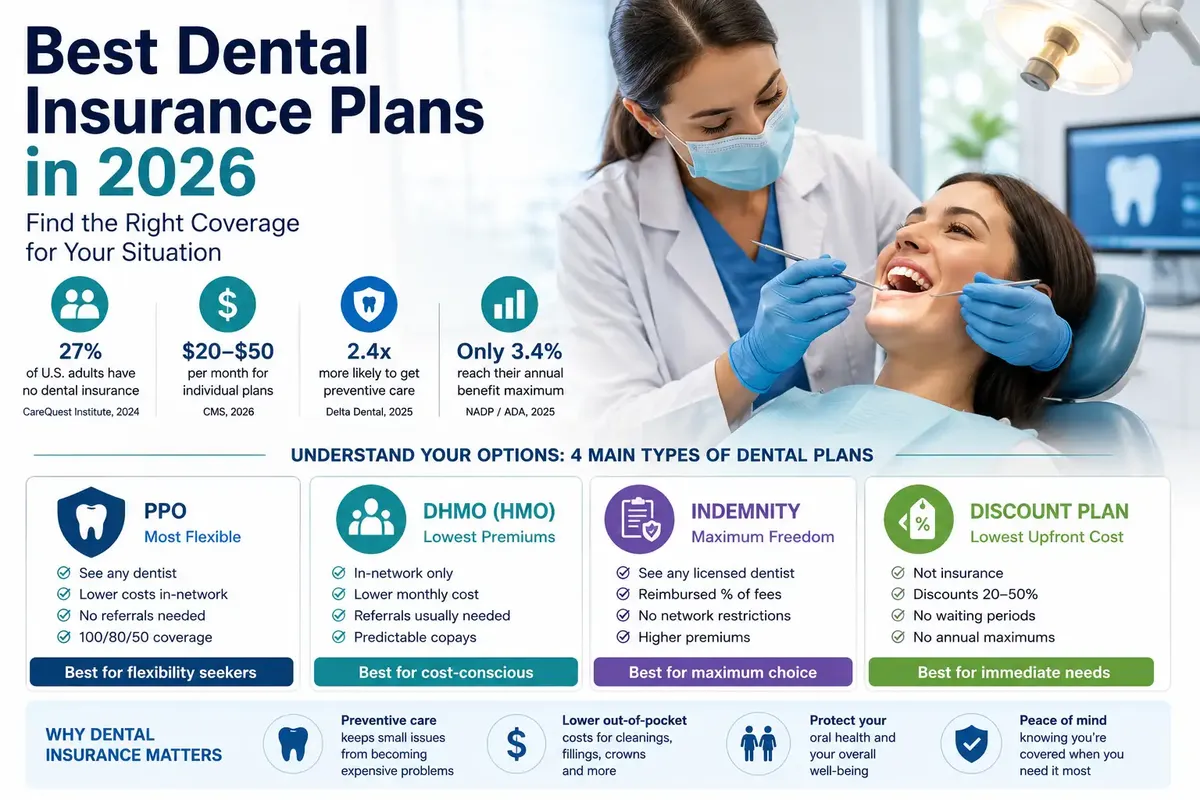
In 2024, Americans spent $189 billion on dental care, with out-of-pocket costs rising 3.3% year over year (ADA Health Policy Institute / CMS (opens in a new tab), January 2026). Without coverage, those costs land entirely on you. This guide explains how to find the plan that actually cuts your bill.
One adult pays a median $21.08/month for a stand-alone plan in the 2026 federal Marketplace, and a family of four about $102/month (our analysis of CMS data)
There's no single best plan — there's only the plan that fits your specific needs. A $2,000 annual maximum looks strong on paper, but if you're facing a crown plus a root canal in the same year, that ceiling won't cover you.
Four factors separate a good plan from an expensive mistake:
Annual maximum: The total the insurer pays per year. Most PPOs top out at $1,500–$2,500. Any major restorative work can blow past that quickly.
Waiting periods: Most plans make you wait 6–12 months before paying for fillings or extractions, and up to 12 months for crowns and bridges (Delta Dental (opens in a new tab), 2025). If you need work done soon, this matters more than the premium.
Network access: PPOs let you see any dentist, with better rates in-network. HMOs restrict you to a network. If your dentist isn't included, you're paying more — or switching providers entirely.
Coverage tiers: Every plan covers preventive care (cleanings, X-rays, exams) at 100%. What they pay for fillings, root canals, crowns, and implants varies significantly.
Worth knowing: Only 3.4% of dental plan members actually exhaust their annual maximum in a given year (NADP/ADA, 2025). That means for most people, the annual max is largely a marketing number. What matters more is the waiting period and the percentage the plan covers for the specific work you're likely to need.
The Four Main Types of Dental Plans
Four structures cover almost every plan you will see. A PPO lets you see any dentist and costs you less in-network, usually on a 100/80/50 split. A DHMO costs less but keeps you in a network, often with referrals for specialists. An indemnity plan reimburses a share of any dentist's fee. A dental discount plan is not insurance: it trades a membership fee for lower prices at participating dentists, with no waiting periods. How each one works, and what it costs, is in types of dental insurance plans.
What Do Dental Plans Actually Cover?
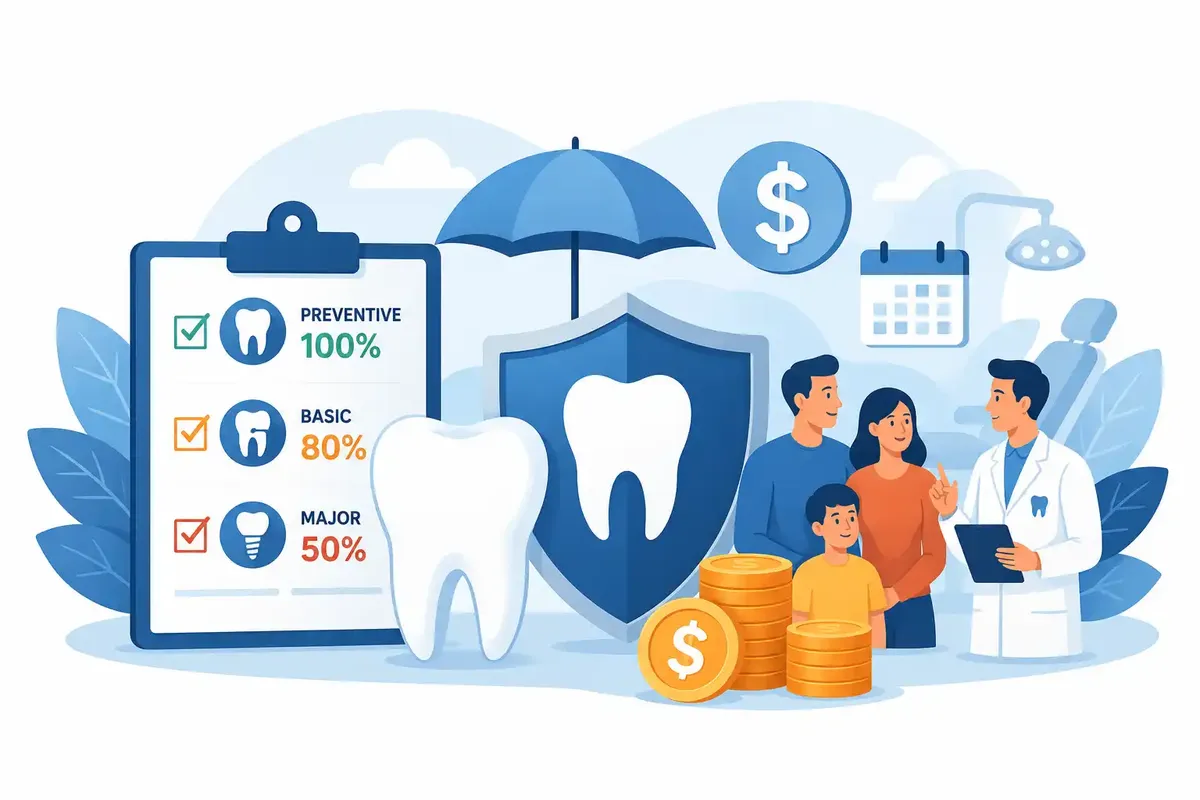
Standard coverage is divided into three tiers. Most PPO plans follow a 100/80/50 structure:
Coverage Tier
What's Included
Typical Plan Pays
Preventive
Cleanings, X-rays, exams, fluoride
100%
Basic
Fillings, extractions, root canals
70–80%
Major
Crowns, bridges, dentures, implants
50%
Orthodontics
Braces, aligners (if included)
50% up to lifetime max
Scroll sideways to see every column →
Preventive care never has a waiting period on any plan — insurers want you catching problems early, before they become expensive claims. Everything else is subject to waiting periods and your annual maximum.
Insured adults are 2.4× more likely to see a dentist for preventive care than those without coverage. Source: Delta Dental, 2025.
Find Your Best Dental Plan: Which Situation Matches Yours?
Your situation determines which plan type will serve you best. Use this table to go directly to the right resource.
Your Situation
What to Prioritize
Deep-Dive Guide
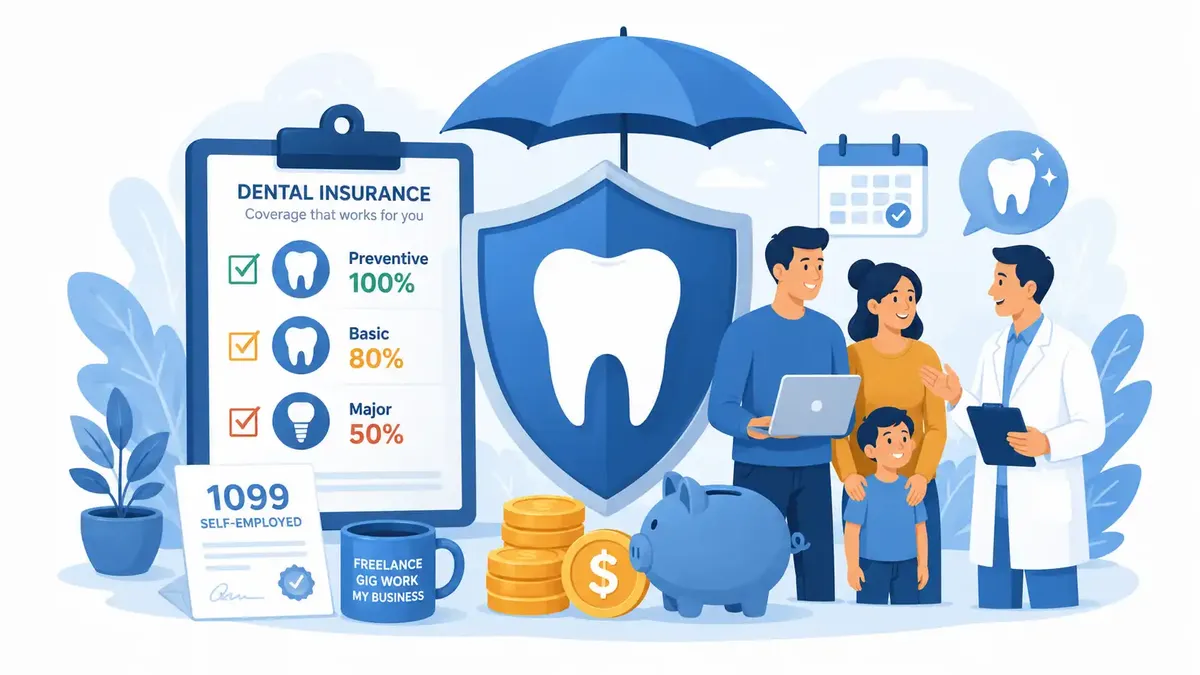
Self-employed, no employer plan
Individual PPO, low waiting periods, high annual max
When you leave an employer, dental coverage goes with it. A stand-alone plan for a single adult lists at a median $21.08 a month in the 2026 federal Marketplace (our analysis of CMS data). That's workable, but the trade-off is usually a lower annual maximum and longer waiting periods than group coverage.
What most freelancers don't think to check: professional association plans (Freelancers Union, NASE) often offer group rates on individual coverage, which can close that gap. The guide to dental insurance for freelancers and 1099 contractors breaks down all options side by side.
If you want to go deeper on the association route specifically, read our guide to dental insurance through professional organizations. It compares options from Freelancers Union, NAR, SAG-AFTRA, NASE, AIA Trust, ASMP, IEEE/ACM, and NFIB, including membership costs, eligibility, dental carriers, and when this route is cheaper than buying an individual plan.
Group Dental Insurance for Self-Employed Workers
Explains how freelancers, sole proprietors, and independent workers can access group-like dental rates without a traditional employer plan. Covers SHOP eligibility, professional associations, Freelancers Union, NASE, local chambers of commerce, spouse employer plans, individual marketplace coverage, membership fees, annual costs, and self-employed dental tax deductions. Read: Group dental insurance for self-employed workers → (opens in a new tab)
Seniors
This is where the coverage gap is most severe. As of 2024, 31 million Americans aged 55 and older have no dental insurance — 31% of that entire age group (NADP Foundation / Charm Economics (opens in a new tab), 2024).
Traditional Medicare explicitly excludes routine dental exams, cleanings, X-rays, fillings, crowns, dentures, and most restorative work. Among Medicare beneficiaries who did use dental services, average out-of-pocket spending was $874 per year — and that's only among people who saw a dentist at all (KFF (opens in a new tab), analysis updated November 2024). The best dental insurance for seniors guide covers what to look for and what to avoid.
Implant Coverage
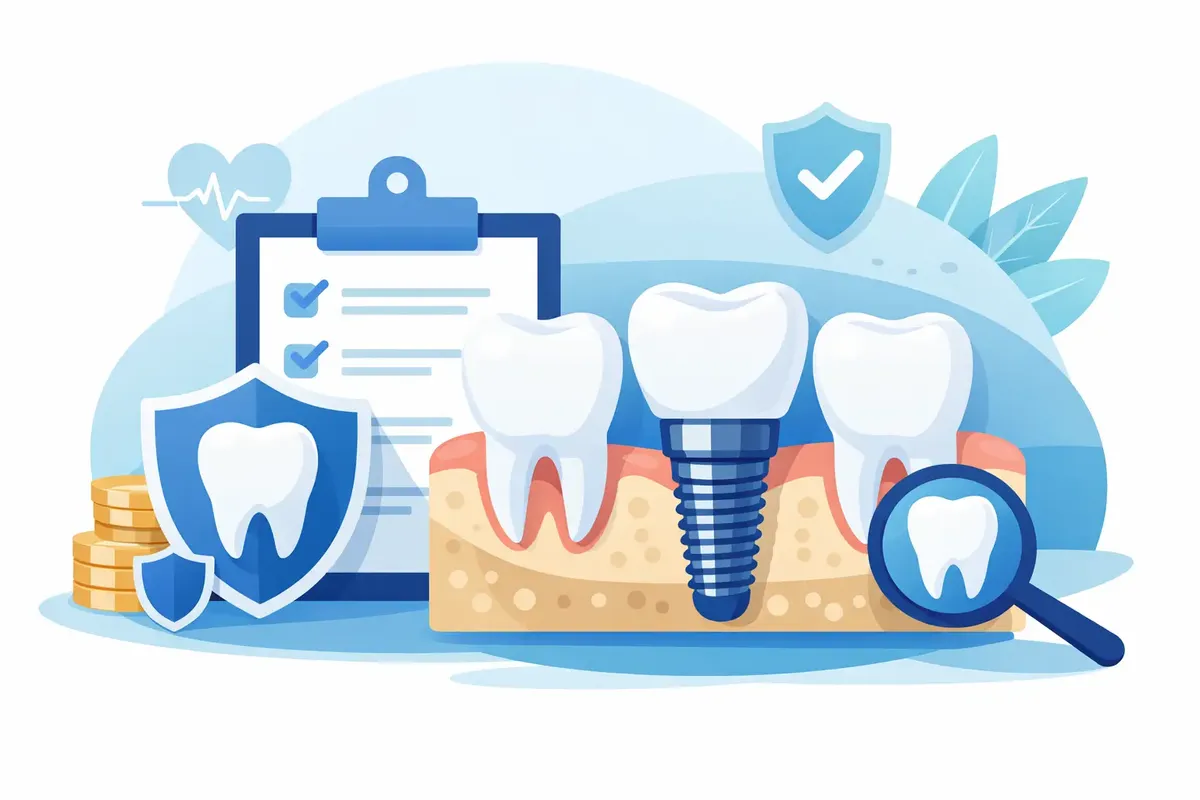
A single implant — post, abutment, and crown — runs $3,000–$6,000 without insurance (SmartArches (opens in a new tab), 2025). Most basic dental plans either exclude implants outright or cover them under the major services tier at 50%, subject to your annual maximum.
Do the math: 50% of a $5,000 implant is $2,500 in coverage, but most plans cap total annual benefits at $1,500–$2,000. You'd exhaust your entire annual benefit on one implant and still owe thousands. The best dental insurance for implants guide identifies plans with meaningful implant coverage.
No Waiting Period
Standard dental plans weren't designed for immediate needs. The 6–12 month wait for basic services and 12-month wait for major work (Delta Dental (opens in a new tab), 2025) means a plan you buy today won't cover your root canal next month.
If you need treatment soon, your realistic options are: a plan that explicitly waives waiting periods (some carriers offer these at higher premiums), a dental discount membership, or negotiating a cash rate directly with a dentist. The best dental insurance with no waiting period guide maps out each option.
How Much Does Dental Insurance Cost in 2026?
For one adult, a stand-alone dental plan usually lists at about $16 to $30 a month in 2026; the median in the federal Marketplace is $21.08 at age 40, and a family of four pays about $102. Your state and the plan's coverage level move the price more than your age does. Prices by age, household and state are in how much dental insurance costs.
Annual maximums matter as much as premiums. About 65% of dental PPOs have an annual maximum of $1,500 or more (NADP; ADA News, December 2025). That's adequate for most years — but a single crown plus a root canal runs $2,000–$3,500, which exceeds most plans' annual cap in one visit.
A practical frame: If you're healthy and need only preventive cleanings, almost any plan covers those at 100% with no waiting period. The question of "which plan is best" only becomes critical when you anticipate restorative or major work in the next 12–18 months — that's when waiting periods, annual caps, and coverage percentages make a real financial difference.
What Dental Insurance Won't Cover
Knowing your plan's limits is as important as knowing what it includes.
Cosmetic work: Teeth whitening, veneers, and aesthetic recontouring aren't covered by any standard plan.
Implants (many plans): Despite the high cost, implants are excluded on many standard plans or covered at rates so low the benefit is marginal.
Orthodontics without a rider: Adult braces and aligners usually require a separate rider. Children's orthodontics is more commonly included on ACA-compliant plans.
Services beyond the annual maximum: Once you hit your annual cap, the plan stops paying until renewal. Spacing major work across two calendar years can double your effective coverage.
Pre-existing conditions (first year): Some carriers limit coverage for conditions that existed before enrollment, particularly for major services.
For a forward look at how coverage structures are evolving, the dental insurance trends 2026 article covers what carriers are adding and dropping. And if you're thinking about the longer arc of individual coverage options, the future of individual dental coverage is worth reading before you commit to a plan.
Frequently Asked Questions
Is dental insurance worth it if I only need cleanings?
For most people, yes. Two cleanings per year at $100–$150 each ($200–$300 total) often exceeds the annual premium on a low-cost individual plan, and you get X-ray coverage included. The real value is protection against unexpected restorative work: catching a cavity early costs $150–$200 with insurance versus $1,200 or more if it progresses to a root canal.
What's the difference between a dental HMO and a PPO?
A dental HMO requires you to choose a primary dentist from a set network and get referrals for specialists — premiums are lower. A PPO lets you see any dentist, with better rates in-network and no referrals needed. If provider flexibility matters to you or you have an existing dentist you want to keep, a PPO is the right choice.
What is a dental waiting period, and can I avoid it?
A waiting period is the time you must be enrolled before the plan pays for certain services. Standard waits are 6–12 months for basic work and 12 months for major work. Preventive care has no waiting period on any plan. Some carriers offer plans with reduced or no waiting periods, usually at a higher premium. See the best dental insurance with no waiting period guide for carriers that waive them.
Is there dental insurance that actually covers implants?
Yes, but it's limited. Standard plans either exclude implants or cover them at 50% under major services — and your annual maximum usually runs out before the implant is fully covered. For meaningful implant coverage you need a plan that explicitly lists implants as a covered benefit with a separate or higher major-services limit. The best dental insurance for implants guide identifies those plans.
What should a family look for in a dental plan?
Families need a plan that covers everyone affordably, includes pediatric dental (required under ACA-compliant plans for children under 19), and ideally carries an orthodontic benefit if braces are on the horizon. Note that the annual maximum typically applies per person — so a family of four each has their own annual cap. The dental insurance for families guide covers how to compare family plans and avoid the most common coverage gaps.
Where to Go From Here
Dental insurance rewards specificity. A plan that works perfectly for a healthy 32-year-old who needs only preventive care is wrong for a 63-year-old facing implant surgery, and wrong again for a freelancer who needs coverage between contracts.
Centers for Medicare & Medicaid Services, 2026 Exchange Rate and Plan Attributes Public Use Files (our analysis), retrieved 2026-09-29, cms.gov (opens in a new tab)
Delta Dental, 2025 State of America's Oral Health and Wellness Report, December 2025, retrieved 2026-06-19, deltadental.com (opens in a new tab)
NADP Foundation / Charm Economics, 31 Million Seniors Lack Dental Coverage, 2024, retrieved 2026-06-19, nadp.org (opens in a new tab)
KFF, Coverage of Dental Services in Traditional Medicare, updated November 2024, retrieved 2026-06-19, kff.org (opens in a new tab)
Pre-existing dental conditions and missing tooth clauses work differently from standard waiting periods. Here's what's actually covered, and what strategies get a known problem treated faster.
Delta Dental reimbursements lag rising overhead costs — up 14–22% since 2021. More practices dropping PPO participation. Here's why and what to do if yours leaves the network.
The best affordable dental plans are not always the cheapest. Learn how to compare premiums, networks, waiting periods, annual maximums, and real value.
On major dental work the annual maximum decides your bill, not the 50% coinsurance. See what 6 named plans pay on $3,900 of work, and when to skip a plan.
Enrolling in VA health care does not include dental. Compare VA direct care, Delta and MetLife VADIP, FEDVIP, private plans, and free-care programs for veterans.
Explore the future of individual dental coverage, including clearer plan comparisons, provider networks, annual maximums, dental discount plans, and smarter shopping tools.
Ameritas dental insurance for families: only PrimeStar Boost covers child braces (15-50% coinsurance, $1,000 lifetime cap). See real costs and reviews.
UnitedHealthcare dental insurance for self-employed buyers starts at $30/month (Primary Dental) up to $200+/month, but the cheapest tier skips major work entirely. See the real trade-offs.
Family dental insurance lists at a median $102/month for a family of four in 2026. Compare PPO, HMO and discount plans and avoid the annual-maximum trap.
Dental and vision insurance for self-employed buyers: see what Humana's $99.99/mo bundle costs vs. mixing carriers, plus the tax deduction that covers both.
65% of dental plans cap benefits at $1,500, and the "missing tooth clause" catches most seniors off guard. See exactly what isn't covered before you enroll.
Americans without dental insurance spend $1,537/year on average. Learn the true annual cost of a PPO plan, how to use an HSA tax-free for dental, the IRS deduction that cuts your premium cost, and a monthly budget template for low, medium, and high utilizers.
Emergency dental exams cost $80-$150 without insurance. A molar root canal runs $1,200-$2,500. Learn what standard dental plans cover in an emergency, which plans have no waiting period, and where self-employed workers can get free or low-cost care today.
At least 10 professional associations offer group-rate dental coverage to self-employed members. Compare Freelancers Union, NAR, SAG-AFTRA, NASE, and more — carriers, costs, and how to join.
Sole proprietors can’t access traditional group dental insurance — but 5 real alternatives offer group-negotiated rates. Learn which options work for self-employed workers, what they cost, and how to enroll.
Only preventive care is covered at 100% on any standard dental plan. Major procedures max out at 50% coinsurance — here is what that means in real dollars.
Humana dental plans for self-employed buyers run $13.99-$46.99/mo with zero waiting periods, but major-work coverage ramps up over 3 years. Full breakdown.