
Dental Insurance for Freelancers & 1099 Contractors (2026)
Updated at: July 17, 2026
If you work as a 1099 contractor, gig worker, or independent freelancer, dental coverage is entirely your problem to solve. No HR department, no benefits portal, no employer contribution. About 59 million Americans did freelance work in 2024 (Upwork, 2024), and the vast majority navigate the individual insurance market on their own — which means understanding exactly how to get dental coverage, what it actually costs, and how to deduct it properly on your taxes.
Key Takeaways
- Freelancers and 1099 contractors can buy individual dental insurance directly from carriers any time of year — no open enrollment window required.
- Individual PPO plans cost $19–$45/month depending on carrier and coverage tier. That's $228–$540/year before the tax deduction.
- Dental insurance premiums are 100% deductible on Schedule 1, Line 17 of Form 1040 as a self-employed health insurance expense — no itemizing required.
- Gig platform workers (DoorDash, Instacart, Uber) are classified as 1099 contractors and qualify for the same individual plans and deductions as other freelancers.
- Income volatility is the biggest practical challenge: choose a plan you can afford in a slow month, not just a good month.
Can 1099 Contractors and Freelancers Buy Dental Insurance?
Yes — individual dental insurance is available to anyone, regardless of employment status. You don't need an employer, you don't need a group minimum, and most plans don't have an open enrollment period. You can start coverage the first of the following month after applying. Delta Dental, Guardian, Cigna, Ameritas, and Spirit Dental all sell directly to individuals.
The main difference from employer-sponsored coverage: you pay the full premium yourself. An employer-sponsored plan might run $0–$15/month for the employee because the employer covers 50–80% of the premium. As a freelancer, you pay the whole thing — typically $19–$45/month for a standard PPO depending on carrier, state, and age. The deduction (explained below) brings that net cost down by 22–37% depending on your tax bracket.
The Tax Deduction Freelancers Almost Always Miss
Dental insurance premiums are deductible as a self-employed health insurance expense under IRC Section 162(l). You claim this on Schedule 1, Line 17 of Form 1040 — not on Schedule A (so you don't need to itemize). The deduction reduces your adjusted gross income directly, which means it lowers both your income tax and, in some cases, your state tax bill.
Three requirements: you must have net self-employment income for the year, you must not be eligible for employer-sponsored dental through a spouse's plan, and the plan must cover you (not just be in your name). That's it. You don't need a business entity — sole proprietors and single-member LLCs both qualify.
At the 22% federal bracket, a $35/month premium becomes a net cost of $27.30/month after deduction. At 24%, it's $26.60. Freelancers in the 32% bracket pay roughly $23.80/month net on the same plan. The deduction alone makes dental insurance meaningfully cheaper than the sticker price suggests.
For a full breakdown of how the deduction works and what to do if your income is irregular, see the self-employed dental tax rules guide.
Which Carriers Are Best for 1099 and Gig Workers?
Individual dental insurance is available from the same carriers whether you're a full-time freelance designer or a part-time DoorDash driver. The key difference between carriers for 1099 workers is price and network — not eligibility. Here's how the main options compare for freelancers specifically:
| Carrier | Monthly Premium | Network Size | Best For |
|---|---|---|---|
| Cigna Dental PPO | $19–$35 | ~92,000 | Urban freelancers watching costs |
| Delta Dental PPO | $30–$45 | 155,000+ | Rural/suburban workers, all 50 states |
| Guardian Direct | $27–$40 | ~110,000 | Freelancers wanting higher annual max ($2K) |
| Ameritas | $25–$38 | 135,000+ | Good balance of price and network |
| Spirit Dental | $35–$75 | ~120,000 | No waiting period — needs work now |
Gig platform workers specifically should check whether their state has ACA Marketplace dental add-ons — in some states, a standalone dental plan purchased through healthcare.gov costs slightly less than buying direct. The coverage is identical; it's a distribution difference. For the full carrier comparison, see the best dental insurance for self-employed guide.
Income Volatility: The Freelancer's Biggest Insurance Problem
The practical challenge of buying dental insurance as a freelancer isn't eligibility — it's cash flow. A month with $8,000 in client income feels very different from a month with $1,400. The premium still comes out regardless.
The right approach: size your premium to what you can pay in a slow month, not what feels comfortable in a good month. A $45/month Delta PPO plan might seem easy when you're billing $6,000/month, but if your income drops 60% in Q1, that $45 still hits. A $22/month Cigna HMO or $27/month Ameritas plan is more sustainable across income cycles — and after the Schedule 1 deduction, the net difference between the two is roughly $16/month.
One exception to the "buy cheap" rule: if you have a known procedure coming up (a crown, a root canal, a cleaning backlog), the 12-month waiting period on major services on most plans means it pays to enroll earlier rather than wait for income to improve. Every month you delay is another month the waiting period clock hasn't started.
Gig Platform Workers: DoorDash, Uber, Instacart, Upwork
If you drive for DoorDash, deliver for Instacart, drive for Uber or Lyft, or freelance on Upwork or Fiverr, you are a 1099 contractor. You receive a 1099-NEC at year end rather than a W-2. This means no employer dental benefits — but it also means you qualify for the Schedule 1 dental deduction on the same terms as any other freelancer.
A few platforms have started offering third-party benefits to gig workers, but these are optional add-ons through brokers like Stride Health or Mettle, not employer-sponsored coverage. They typically aggregate individual market plans rather than providing group insurance. The plans themselves are the same products you'd buy direct — you're just using the platform as a distribution channel. Buying direct from the carrier is usually the same price or cheaper.
Freelancers Union (freelancersunion.org) offers group dental rates to members in select states. If you're in New York, New Jersey, or Connecticut, membership may get you access to group pricing that beats the individual market — worth checking before buying direct.
Freelancers Union is not the only path worth checking. Some trade groups, unions, and professional associations negotiate dental benefits or member-only dental access for specific professions. For a deeper breakdown, see our guide to professional association dental plans, including options from Freelancers Union, NAR, SAG-AFTRA, NASE, AIA Trust, ASMP, IEEE/ACM, and NFIB.
Waiting Periods and What to Do If You Need Work Now
Most individual dental plans have a 12-month waiting period on major services (crowns, root canals, dentures) and a 6-month waiting period on basic restorative (fillings, simple extractions). Preventive care — cleanings, exams, X-rays — is covered from Day 1 on virtually every plan.
If you need a crown or root canal now and can't wait 12 months, two options:
- Spirit Dental — offers no-waiting-period plans at higher premiums ($35–$75/month). Worth the premium if you have immediate major work pending; the math usually favors it if the procedure exceeds $600. See no-waiting-period dental plans for a full comparison.
- Dental savings plan + cash — pay an annual membership fee ($100–$200) and get 20–50% off the dentist's standard rate. Not insurance, but no waiting period either. Works well as a bridge before your insurance waiting period clears.
For regular preventive care only (you just want cleanings covered), any standard PPO is fine — preventive is covered from Day 1 regardless of carrier. Don't pay Spirit's premium if all you need is cleanings and X-rays. A $22–$27/month Cigna or Ameritas plan covers those from enrollment.
What Coverage Structure Should Freelancers Expect?
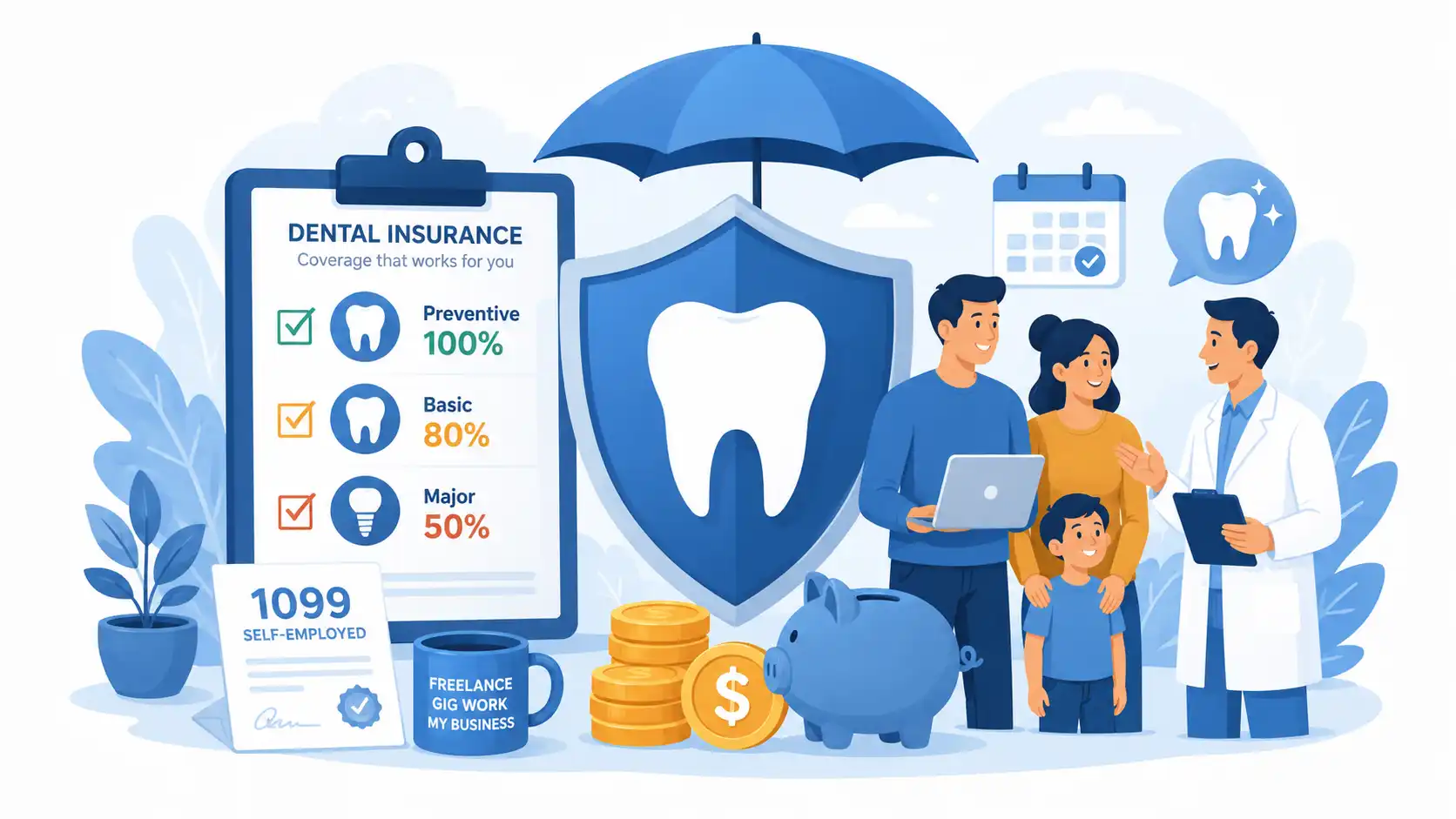
Every standard individual dental insurance plan in the US uses the 100/80/50 structure:
- 100% — Preventive: routine cleanings (twice yearly), annual exam, X-rays, fluoride. No deductible, no coinsurance, from Day 1.
- 80% — Basic restorative: fillings, simple extractions. You pay 20% after the deductible, typically after a 6-month waiting period.
- 50% — Major services: crowns, root canals, bridges, dentures. You pay 50% after the deductible, typically after a 12-month waiting period.
Annual maximums cap total benefits — most base-tier plans max at $1,000/year, which runs out after one crown plus a couple fillings. If you expect significant restorative work, look for plans with $1,500–$2,000 annual maximums. Guardian Direct and some Ameritas tiers offer $2,000 annual maximums at mid-tier pricing. For more detail on how these limits play out in real procedures, see what dental plans actually cover at each tier.
ACA Marketplace vs. Stand-Alone Dental for Freelancers
Freelancers who buy their health insurance through healthcare.gov (ACA Marketplace) have the option to add dental through the same marketplace or buy stand-alone dental direct from a carrier. The coverage is identical either way — the difference is administrative.
ACA dental add-ons have two tiers: "pediatric" (embedded in health plans) and "adult standalone." Adult standalone dental on the ACA Marketplace works exactly like buying direct from Delta or Guardian, but your premium is part of the health plan billing. In most states, buying direct is equally priced and simpler. In a few states, ACA marketplace rates are slightly subsidized depending on your income.
For a detailed breakdown of the ACA vs stand-alone decision, see ACA Marketplace vs stand-alone dental insurance.
Frequently Asked Questions
Can freelancers deduct dental insurance premiums on their taxes?
Yes. Dental insurance premiums are deductible as a self-employed health insurance expense on Schedule 1, Line 17 of Form 1040. The deduction reduces your adjusted gross income directly — you don't need to itemize. The only requirements: you must have net self-employment income for the year, and you must not be eligible for a subsidized employer plan through a spouse's benefits.
What is the best dental insurance for 1099 contractors?
For most 1099 workers in major metros, Cigna Dental PPO ($19–$35/month) offers the best price-to-coverage ratio — check that your dentist is in network first. For rural or suburban workers who need broader network access, Delta Dental PPO ($30–$45/month) covers 155,000+ dentists in all 50 states. Guardian Direct is worth considering if you expect restorative work — its $2,000 annual maximum is higher than most base-tier plans.
How do gig workers (DoorDash, Uber, Instacart) get dental insurance?
Gig platform workers are 1099 contractors and buy individual dental insurance the same way any freelancer would — directly from carriers like Delta Dental, Cigna, Guardian, or Ameritas. Some platforms offer optional benefits through third-party brokers (Stride Health, etc.), but these are the same individual market plans you can buy direct, often at the same price. The Schedule 1 tax deduction applies to gig workers on the same terms as other self-employed individuals.
Is there dental insurance without waiting periods for freelancers?
Spirit Dental offers individual plans with no waiting periods on major services. Premiums are higher ($35–$75/month) than standard plans, but if you need a crown or root canal now and can't wait 12 months, the math often favors it. Some Ameritas premium tiers also offer reduced or waived waiting periods. For a full comparison, see the no-waiting-period dental insurance guide.
Can freelancers join a group dental plan?
In most states, no — individual market plans are the primary option for solo freelancers. Exceptions: Freelancers Union offers group dental in select states (NY, NJ, CT) to members. Some professional associations (American Institute of Graphic Arts, National Press Photographers Association, etc.) offer group rates to members. Check whether your professional association has a group dental option before defaulting to the individual market.
Bottom line: Freelancers and 1099 contractors have full access to individual dental insurance — the market is open, plans start at $19/month, and the Schedule 1 deduction makes the real cost meaningfully lower than the premium. Size your plan to what you can afford in a slow month, check your dentist's network participation before enrolling, and if you need major work now, look at Spirit Dental's no-waiting-period options. For the full carrier comparison including Guardian, Ameritas, and Aetna, see the best dental insurance for self-employed guide.
This article is part of the Best Dental Insurance Plans hub. Also see: best dental insurance for self-employed — dental insurance for families — plans with no waiting period.
For a look at where premiums and coverage are headed, see our 2026 dental insurance trends.