
The short answer is: only for preventive care. No individual dental insurance plan in the US covers 100% of major procedures like crowns, root canals, or dentures — at least not in the first year, and not on standard plans. But the longer answer matters more, because “100% coverage” means different things in different contexts, and understanding the difference can save you from buying a plan that falls apart the first time you need it.
Key Takeaways
- Preventive care (cleanings, exams, X-rays) is covered at 100% on virtually every dental insurance plan from day one — this is the standard.
- No standard dental plan covers 100% of major procedures like crowns, root canals, or dentures. The best you’ll find is 50% coinsurance after the deductible on major services.
- Some dental discount plans market “no limits” or “full savings” language that sounds like 100% coverage — these are not insurance, and your out-of-pocket costs can still be significant.
- A few premium-tier plans cover basic restorative at 100% after the deductible, but these carry higher premiums and annual maximums that cap total benefits anyway.
- The closest real-world option to “100% coverage” is a combination: a standard PPO plan (preventive at 100%, major at 50%) plus a funded HSA or dental savings account to cover the remaining coinsurance.
What “100% Coverage” Actually Means in Dental Insurance
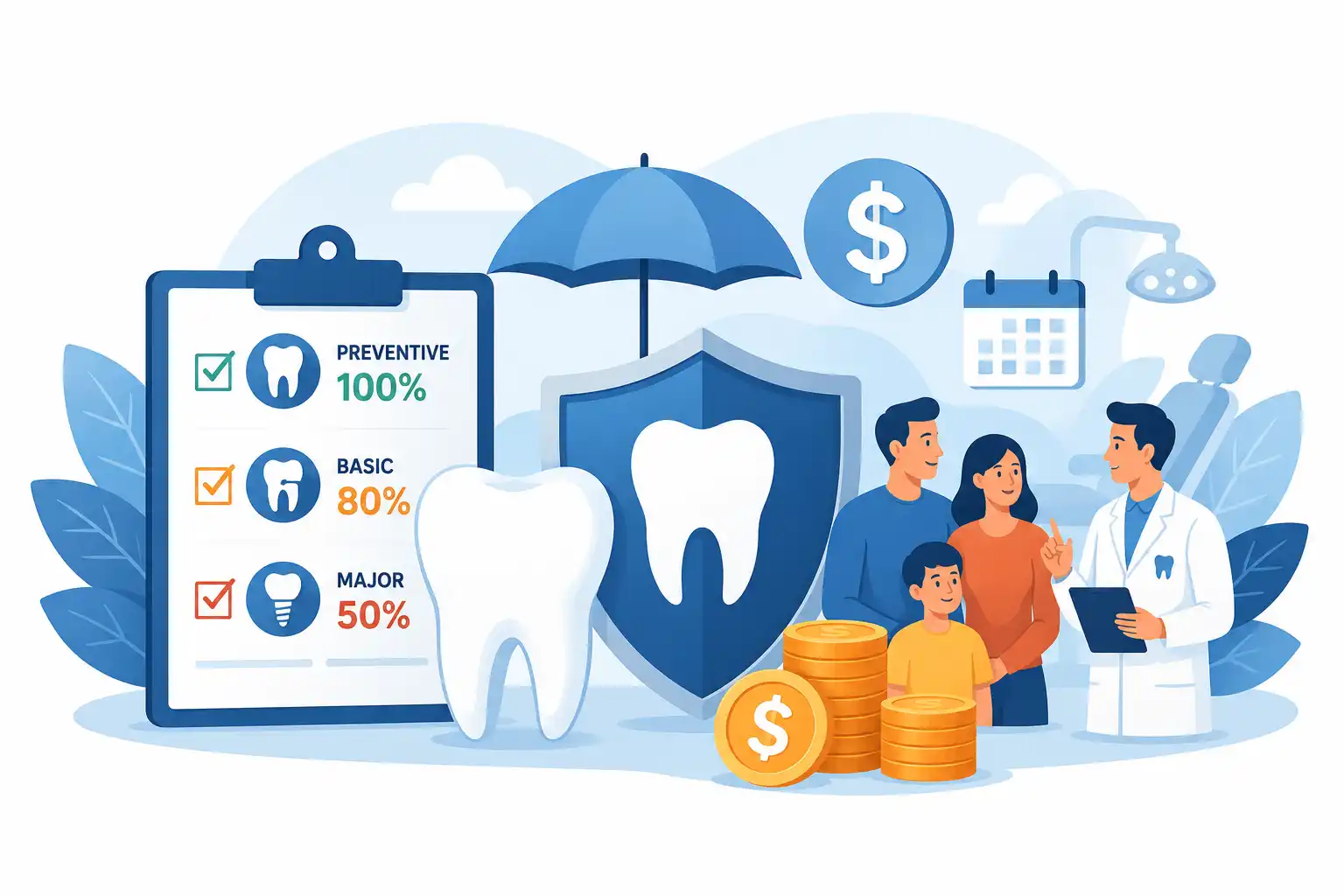
Every standard individual dental insurance plan in the US is built on a 100/80/50 structure — and only the first number is actually 100%. That structure means:
- 100% on preventive care: routine cleanings (2 per year), annual exams, diagnostic X-rays. Covered from Day 1 on virtually every plan.
- 80% on basic restorative: fillings, simple extractions, periodontal treatment. You pay 20% coinsurance after the deductible, typically after a 6-month waiting period.
- 50% on major services: crowns, root canals, bridges, dentures, surgical extractions. You pay 50% after the deductible, typically after a 12-month waiting period.
The 100% for preventive care is genuine — there’s no deductible, no coinsurance, and no annual maximum that applies separately to preventive visits. But it’s the only true 100% in a standard plan. For everything else, you share the cost.
Do Dental Discount Plans Cover 100%?
No — and this is where a lot of buyers get confused. Dental discount plans (sometimes called dental savings plans) are membership programs, not insurance. You pay an annual fee ($100–$200/year is typical) and get access to a network of dentists who agree to charge reduced rates — often 20–50% off their standard fees. There are no coverage percentages, no deductibles, no claims, and no annual maximums.
The marketing language around discount plans can sound like “save up to 60%” or “no limits, no waiting,” which reads like broad coverage. But you’re paying the discounted fee yourself, out of pocket, every time. A root canal that normally costs $1,165 might cost $700 on a discount plan — you’ve saved $465, but you’re still paying $700. That’s not 100% coverage.
Dental discount plans have legitimate uses — particularly when you need work done immediately and can’t wait out a 12-month waiting period on a standard plan. But they’re not a substitute for insurance on major procedures.
Are There Any Plans That Cover More Than 50% on Major Work?
A handful of premium-tier and specialty plans cover major services at 60–80% rather than the standard 50%, but these come with three trade-offs:
- Higher premiums: Plans covering 80% on major work typically cost $50–$90/month for individual coverage vs $27–$40/month for a standard 50% plan.
- Annual maximums still apply: Even at 80% coinsurance, most plans cap total annual benefits at $1,500–$3,000. A complex restorative case can exceed that in a single appointment.
- Waiting periods still apply: The 12-month waiting period on major services exists on most enhanced-tier plans too, unless you’re buying from Spirit Dental or specific no-waiting-period carriers. See plans with no waiting periods.
The math on premium-tier plans rarely works out better than a standard PPO plus a funded dental savings account or HSA. A $30/month standard plan at 50% coinsurance costs $360/year. A $70/month enhanced plan at 80% coinsurance costs $840/year — you’d need to use $1,200+ in major services annually for the enhanced plan to break even on the premium difference alone.
The Closest Real-World Option to “Full Coverage”
No single plan provides 100% coverage on everything. But the combination most individual buyers use to get closest to full coverage is:
- A standard PPO plan (100% preventive, 80% basic, 50% major) — covers the predictable stuff fully and reduces catastrophic exposure on major work
- A Health Savings Account (HSA) or dental emergency fund — pre-tax dollars that cover your 50% coinsurance share on major procedures, deductibles, and anything above the annual maximum
Self-employed workers with a high-deductible health plan (HDHP) can contribute to an HSA and use those pre-tax dollars for dental coinsurance. That’s effectively a 22–37% additional discount on whatever your dental plan doesn’t cover, depending on your tax bracket. Combined with the Schedule 1 premium deduction, this is the closest individual buyers get to “full coverage” without paying $80–$100/month for a premium-tier plan.
For a full breakdown of what individual dental insurance costs and what it actually covers in real scenarios, see the average dental insurance cost guide and whether dental insurance is worth it.

What to Look for If You Want Maximum Coverage
If maximizing coverage depth is your goal, prioritize these four plan features over the headline “100% coverage” claim:
- Annual maximum: $2,000+ is significantly better than the standard $1,000. One crown + root canal averages $2,564 total (Guardian/Synchrony 2024). A $1,000 annual max runs out halfway through that single procedure.
- Major services coinsurance: 60–80% beats the standard 50% if you expect crown or root canal work and can absorb the higher premium.
- No waiting period on major work: If you need work now, a no-waiting-period plan at higher premium is worth more than the standard plan’s 50% coinsurance that you can’t use for 12 months anyway.
- Implant coverage: Most base-tier plans exclude implants entirely. If implants are in your future, look for plans that include implant coverage after Year 2 (Spirit Dental, some Ameritas tiers).
See the full carrier comparison for self-employed buyers in the best dental insurance for self-employed guide, and compare the top options by category at the best dental insurance hub.
Frequently Asked Questions
Do any dental plans cover 100% of everything?
No. Every individual dental insurance plan in the US covers preventive care (cleanings, exams, X-rays) at 100%, but basic restorative and major services require coinsurance — you pay 20% on fillings and 50% on crowns or root canals under a standard plan, even after hitting the deductible. No standard individual plan covers 100% of major procedures. Annual maximums ($1,000–$2,000) also cap total benefits.
What dental procedures are covered at 100%?
On virtually every standard dental plan: routine cleanings (2 per year), dental exams, diagnostic X-rays, fluoride treatments, and sealants for children. These are classified as preventive care and are covered from Day 1 with no deductible and no coinsurance. Everything beyond preventive care — fillings, extractions, crowns, root canals — requires you to pay a percentage of the cost.
Is there dental insurance with no out-of-pocket costs?
Not for major procedures on any standard individual plan. You’ll always pay 20% on basic restorative and 50% on major services after the deductible. The closest option for reducing out-of-pocket costs on major work: a premium-tier plan with 80% major-service coverage (higher premium), combined with an HSA to cover the remaining 20% with pre-tax dollars.
What is the best dental plan for someone who needs a lot of work?
If you need work done soon and don’t want to wait 12 months: Spirit Dental or select Ameritas no-waiting-period tiers. If you can wait and want maximum annual coverage: look for plans with $2,000+ annual maximums and 60–80% major-service coverage. In any case, verify the plan’s annual maximum before enrolling — a $1,000 cap runs out after one crown. Compare no-waiting-period options here.
Bottom line: No dental plan covers 100% of everything. Preventive care is covered at 100% by every standard plan; that’s where the “100%” promise ends. Major work maxes out at 50–80% coinsurance depending on plan tier. The smartest approach for individual buyers is a solid PPO plan plus an HSA or dental fund to cover the coinsurance gap — not hunting for a plan that promises full coverage and doesn’t deliver it.
Related guides: For a full breakdown of what a typical plan covers, see what dental insurance actually covers, or compare the best affordable dental plans if 100% coverage isn’t realistic for your budget.