In Network vs Out of Network Dentist
Understand how in-network and out-of-network dentists affect your dental insurance costs, claims, provider choice, and out-of-pocket bills.
Read guide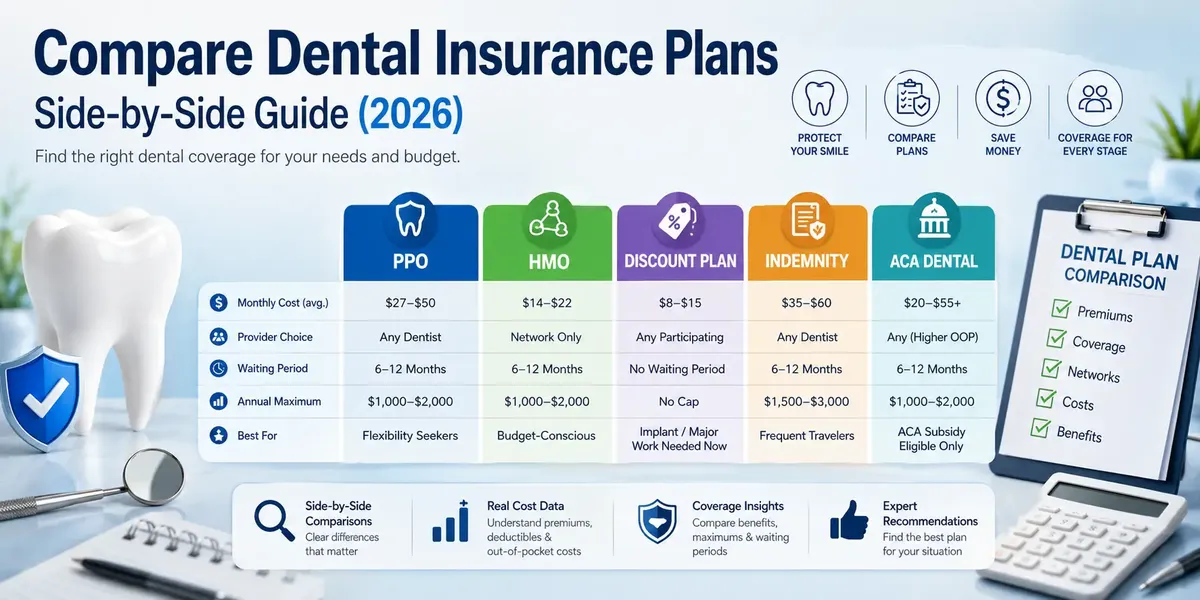
Written and reviewed by Alex Carter, Editor & Content Reviewer at Dental Coverage Guide. See our editorial policy.
The right dental plan depends on which question you are trying to answer. PPO or HMO? Insurance or discount card? Stay in-network or pay more for any dentist? Buy through the ACA marketplace or direct from a carrier? These are not the same question, and the answers point toward different plans. This hub collects every head-to-head comparison we have published at Dental Coverage Guide. Each guide covers a specific decision — with side-by-side cost data, coverage differences, and a clear recommendation for who each option fits best.
Plan types differ on four things: the monthly cost, which dentists you can see, how long you wait for major work and how much the plan pays in a year. A PPO gives you any dentist, an HMO costs less but keeps you in a network, and a discount plan skips waiting periods but pays nothing toward the bill. For a step-by-step way to weigh two plans, see how to compare dental insurance plans; for the cost math on the most common choice, see PPO vs HMO dental insurance.
These three guides address the most common first decision: which type of dental coverage makes sense for you. Each comparison covers real cost data, coverage structure, and a clear verdict based on your situation.
Delta Dental is the largest dental insurer in the United States by network size. If you are comparing a Delta Dental plan against a competing carrier, these guides provide a direct cost and coverage breakdown for the individual market in 2026.
The last three comparisons address how you pay for care rather than which plan type to buy. Whether to go in-network or out-of-network, whether to pay cash vs. use a plan, and whether a dental savings membership delivers more value than a traditional policy — these guides answer each question with actual cost data.
Provider access is the primary difference. A PPO plan lets you see any licensed dentist and still receive partial reimbursement even for out-of-network visits. An HMO plan restricts you to a network of participating dentists and pays nothing if you go outside it. HMOs usually cost less per month, which suits patients whose dentist is already in the network, but they are a problem if you travel often or live where few dentists take HMO plans. The PPO vs HMO comparison runs the cost math for both.
No — and the distinction matters. A dental discount plan (or dental savings plan) is a membership program that negotiates reduced fees at participating dentists. You pay the dentist directly at the discounted rate — the plan pays nothing toward your bill. Traditional dental insurance pays a portion of your bill after your deductible, up to your annual maximum. Discount plans have no annual maximums and no waiting periods, which makes them useful for patients who need major work immediately or who have already exceeded their annual maximum on their insurance.
For most individual buyers, buying directly from a carrier offers better value. ACA marketplace dental plans — especially embedded dental within medical plans — often cost more than equivalent standalone plans, limit your carrier choices, and add administrative complexity. The exception: if you qualify for ACA income-based subsidies on medical coverage, a bundled dental add-on may make financial sense. Self-employed workers buying on the individual market directly typically get more plan choices at lower premiums outside the marketplace.
Going out-of-network makes sense in three situations: your preferred dentist does not participate in any available network, you need a specialist not available in your plan's network, or you are traveling and need emergency care. On a PPO plan, out-of-network visits are still partially covered — typically at 50–80% of the plan's allowable amount, minus balance billing. On an HMO, out-of-network care is not covered at all except in genuine emergencies. Always confirm out-of-network cost-sharing before booking an appointment.
It depends on how much dental work you use. For preventive-only patients (two cleanings, X-rays, one exam per year), an HMO or dental discount plan typically produces the lowest total annual cost. For patients who need one or two fillings per year, a PPO usually breaks even or comes ahead of paying cash. For major work (crown, root canal, dentures), your choice of annual maximum and waiting period matters more than the plan type — a discount plan or high-maximum PPO often wins over a standard $1,000-maximum policy for large procedures.
Related reading: Aetna vs Delta Dental, Cigna vs Delta Dental, and ACA Marketplace vs stand-alone dental insurance.
Understand how in-network and out-of-network dentists affect your dental insurance costs, claims, provider choice, and out-of-pocket bills.
Read guideComparing cash dentist vs dental plan costs? Learn when paying cash beats coverage, when plans help more, and how to choose based on your needs.
Read guideComparing dental discount plan vs insurance? Learn how costs, waiting periods, networks, and coverage differ so you can choose with confidence.
Read guideCigna costs 20-35% less than Delta Dental for individual plans - but its network is 40% smaller. Here's how to decide which trade-off makes sense for your situation.
Read guideDelta Dental implant coverage varies by regional plan — typically 30-50% after a 6-24 month wait, capped by a $1,500-$2,000 annual max.
Read guideAetna and Delta Dental cover the same procedures at the same rates - the difference is network consistency and where you can buy. Here's the honest comparison for individual buyers in 2026.
Read guideCMS found 48.74% of Medicare Advantage provider listings had an error. Here's exactly how to find a dentist who'll actually treat you, not just one listed.
Read guideMedicare Advantage dental vs. standalone insurance: real 2026 costs, annual maximums, network rules, and enrollment timing compared side by side.
Read guideEmployer dental coverage usually ends at retirement, not your birthday. See COBRA limits, Medicare's dental gap, and your real options at 65.
Read guideCompare PPO vs HMO dental insurance, including dentist choice, monthly costs, deductibles, referrals, out-of-network coverage, and which plan may fit your needs.
Read guideACA Marketplace dental and stand-alone plans use the same carriers and coverage structure - but enrollment timing, price, and plan variety differ. Here's how to pick the right path.
Read guideDental savings plans can lower costs at participating dentists, but they are not insurance. Learn how they work, when they help, and what to check first.
Read guide