Dental Insurance for Self-Employed & Individual Buyers (2026)
Finding dental insurance on your own is harder than it looks. There is no HR department, no pre-selected plan list, and no employer covering half the premium. Every guide on this site is written to give you a direct answer to one specific question, with real cost data and plan examples.
Plans with no waiting period, and what to do when coverage cannot start in time.
How dental insurance works
The key numbers in every plan
Most confusion about dental insurance comes from misunderstanding a few numbers that appear in every plan. Here is what each one means and why it matters.
Monthly premium
What you pay every month, whether you use the plan or not.
Dental insurance costs depend on more than the monthly premium. Learn what affects dental plan prices, how individual and family costs differ, and how to estimate your real yearly out-of-pocket cost.
Compare PPO vs HMO dental insurance, including dentist choice, monthly costs, deductibles, referrals, out-of-network coverage, and which plan may fit your needs.
Original Medicare doesn't pay for dental implants, even inside its dental exceptions. We counted CMS data on 3,553 Medicare Advantage plans for 2027 to see which ones do.
Humana dental plans for self-employed buyers start at $12.99 a month and three have no waiting periods, but major work pays slowly. Updated October 2026.
We pulled Humana's quotes in 10 states and read its Florida plan documents. Age doesn't raise the price after 65, but most plans won't replace teeth you already lost.
Content at Dental Coverage Guide is written and reviewed by Alex Carter, Editor & Content Reviewer. All guides are reviewed for accuracy, clarity, and practical usefulness before publication. For educational purposes only, not professional insurance or financial advice.
We do not sell dental insurance or process applications, and no carrier has editorial influence over our content.
Sourced and dated
Guides cite their sources and show when they were last updated.
Clear about money
Some links are affiliate links. They are labeled, and they never decide what we recommend.
Quick answers
Common questions, answered briefly
How much does individual dental insurance cost per month?
For one adult, a stand-alone dental plan usually costs about $16 to $30 a month in 2026. The median plan on HealthCare.gov lists at $21.08 a month for a 40-year-old, and a family of four pays a median of about $102. Plans with richer coverage cost more: at the Marketplace’s high coverage level the median is $33.02 a month, versus $17.80 at the low level. For self-employed workers, the premium is 100% tax-deductible on Schedule 1, Line 17, reducing the effective monthly cost by your marginal tax rate. See the full cost guide for prices by age, household and state.
Yes — anyone can buy individual dental insurance directly from a carrier at any time of year. There is no open enrollment window for standalone dental plans (unlike ACA health insurance). Your options include buying directly from carriers like Delta Dental, Guardian, Cigna, Aetna, or Ameritas; purchasing a dental add-on through the ACA marketplace; or joining a dental discount membership. See buying dental insurance without an employer for a full breakdown of each channel.
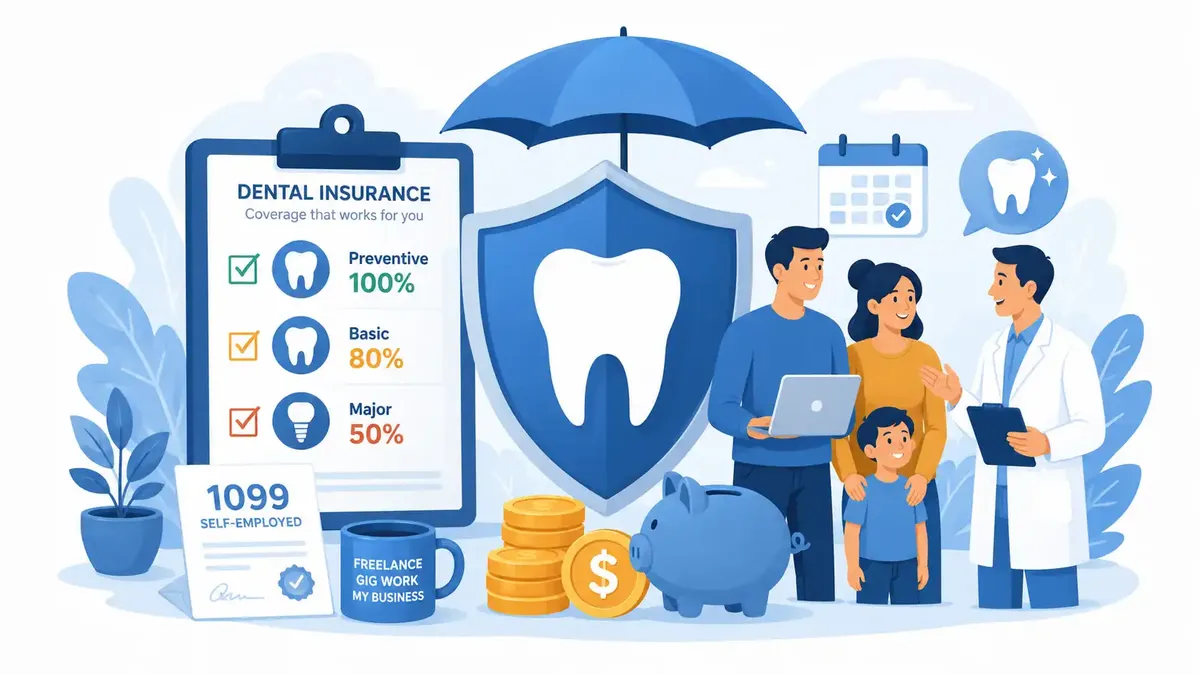
Most plans divide procedures into three tiers: preventive (cleanings, X-rays, exams — covered at 100%), basic (fillings, simple extractions — covered at 70–80%), and major (crowns, root canals, dentures — covered at 50%). All coverage is subject to an annual maximum, typically $1,000–$2,000. Most plans exclude implants or cover them at minimal amounts. Braces are covered only by plans with orthodontic riders, usually with a one-time lifetime maximum of $1,000–$1,500. See what dental insurance covers for the full breakdown.