Dental Insurance for Braces: Coverage, Limits, and Costs
Dental insurance may help pay for braces, but age limits, waiting periods, lifetime maximums, and network rules can significantly affect its value.
Read guide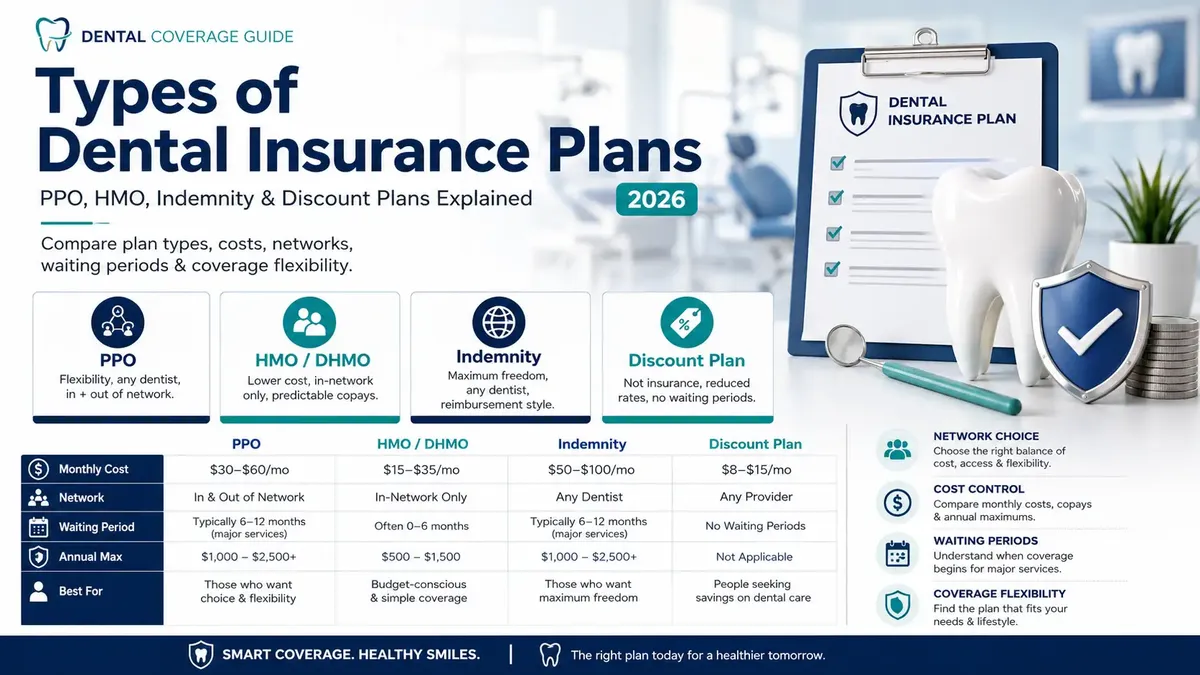
Written and reviewed by Alex Carter, Editor & Content Reviewer at Dental Coverage Guide. See our editorial policy.
The type of dental plan you choose shapes almost every aspect of your coverage: which dentists accept your plan, how much you pay each visit, whether you need referrals, and how long you wait before your plan covers fillings or crowns. Understanding plan structure first — before comparing specific insurers or monthly premiums — is the fastest path to finding coverage that actually works for your situation.
This hub covers the four main dental plan types, explains how each works, and links to in-depth guides on every aspect of dental insurance that affects plan-type decisions: how dental insurance works, what it covers, waiting periods, exclusions, how to compare plans, and how to buy.
Dental insurance in the United States is sold through four primary plan structures. Each one handles the relationship between you, your dentist, and your insurer differently.
Dental plan type comparison across cost, network, waiting periods, and coverage structure. Source: NADP Dental Benefits Report, 2025.
PPO plans are the most widely purchased individual dental plan type in the US. The core feature is network flexibility: you can visit any licensed dentist. When you stay in-network, the insurer has pre-negotiated rates with the dentist, reducing your share of the bill. Going out of network is allowed but costs more — the plan reimburses at a lower "usual and customary" rate and you pay the difference.
Coverage typically follows the 100/80/50 structure: preventive care (cleanings, X-rays, exams) at 100%, basic services (fillings, extractions) at 80% after a deductible, and major services (crowns, root canals, bridges) at 50%. Most individual PPO plans carry a $1,000–$2,000 annual maximum and a 6–12 month waiting period on non-preventive services.
Monthly premiums for individual PPO plans range from $30–$60 for basic coverage to $50–$80 for premium tiers with higher annual maximums or shorter waiting periods. PPO plans work well for self-employed individuals, freelancers, and anyone who values the ability to keep their existing dentist. See PPO vs HMO dental insurance: which type fits your situation for a detailed side-by-side comparison.
HMO dental plans (also called DHMO — Dental Health Maintenance Organization) offer the lowest monthly premiums of any insurance plan type, typically $15–$35 per month for individual coverage. The trade-off is a restricted provider network: you choose a primary care dentist from the plan's list and must use in-network providers for all covered services. Out-of-network care is not covered except in emergencies.
Instead of coinsurance percentages and deductibles, HMO plans often use fixed copays per procedure. A cleaning might cost $0–$15, a filling $20–$50, and a crown $200–$350 — regardless of what the dentist normally charges. This makes costs predictable. Many HMO plans also waive waiting periods entirely, which makes them worth considering if you need basic care soon after enrolling.
HMO plans make the most sense when you live in an area with a strong HMO network, your preferred dentist participates, and cost reduction is more important than provider flexibility. They are less suitable for people who travel frequently or live in rural areas with limited network density.
Indemnity plans are the oldest and most flexible form of dental insurance. You visit any dentist you choose — there is no network — and submit a claim afterward. The insurer reimburses a fixed percentage of the procedure's "usual, customary, and reasonable" (UCR) fee. If your dentist charges above the UCR rate, you pay the difference on top of your coinsurance share.
Premiums are higher ($50–$100/month for individual coverage) and annual maximums can reach $2,500–$3,000 on better plans. Indemnity plans suit people with long-term relationships with a specific dentist who is not in any major network, or individuals in areas with sparse PPO networks. They are less common today — most major insurers have shifted to PPO and HMO structures — but specialty carriers still offer them.
Dental discount plans are not insurance. They are membership programs that give you access to a network of participating dentists who have agreed to charge members reduced rates — typically 20–50% below their standard fees. You pay the discounted rate directly to the dentist at the time of service. There are no claims, no deductibles, no annual maximums, and no waiting periods.
Monthly costs range from $8–$15 for individuals. Coverage activates in 1–3 business days, making discount plans the fastest path to reduced-cost dental care. Popular networks include Careington, Aetna Dental Access, and Cigna Dental Savings. For a detailed comparison of when a discount plan makes more financial sense than traditional insurance, see dental discount plan vs insurance.
Each article below covers a specific aspect of dental plan types in depth. Together they answer the full set of questions you need to evaluate, compare, and buy dental coverage.
Explains the mechanics behind every plan type: premiums, deductibles, copays, coinsurance, annual maximums, and the 100/80/50 coverage structure. If you are new to dental insurance or switching from employer coverage to an individual plan, this is the right place to start. Covers how claims are processed, what "allowed amount" means, and why in-network vs out-of-network status affects every number on your EOB. Read: How dental insurance works →
A procedure-by-procedure breakdown of what falls under preventive (cleanings, X-rays, sealants), basic (fillings, simple extractions, emergency exams), and major (crowns, root canals, dentures, bridges) service tiers. Explains the 100/80/50 rule, how coverage percentages apply after the deductible, and which procedures are almost never covered (cosmetic whitening, implants on many plans, orthodontics without a rider). Read: What dental insurance covers →
Waiting periods are the most common source of disappointment for new dental insurance buyers. This guide explains why they exist, how long they last by service tier (preventive: 0 days, basic: 6 months, major: 12 months, orthodontics: 12–24 months), which plan types are most likely to waive them, and how to time your enrollment to minimize the wait before you need work done. Read: How waiting periods work and how to avoid them →
Every dental plan includes a list of services it will not cover. Cosmetic procedures, implants (on most plans), pre-existing condition clauses, frequency limitations, and age restrictions are among the most common exclusions. This guide walks through each exclusion category, explains the language insurers use in plan documents, and tells you what questions to ask before you enroll to avoid surprises at the checkout counter. Read: Dental insurance exclusions explained →
A decision framework for selecting between plan types based on your specific situation: current dental health, dentist preference, anticipated procedures, budget, and location. Includes a step-by-step evaluation guide, the five numbers that determine a plan's real value beyond the monthly premium, and how to read a Summary of Benefits to compare plans accurately. Read: How to choose dental coverage →
Step-by-step walkthrough of buying a standalone individual dental plan: where to shop (insurer directly, dental.com, eHealth), what to look for in plan documents, how to verify your dentist is in-network before enrolling, and how to avoid common enrollment mistakes. Covers ACA marketplace dental vs standalone plans and the enrollment timing strategy that maximizes your annual maximum. Read: How to buy individual dental insurance →
Orthodontic coverage is one of the most misunderstood plan features. This guide covers how lifetime orthodontic maximums work (separate from the annual maximum), how children's ACA coverage differs from adult coverage, why waiting periods for orthodontics are 12–24 months, whether clear aligners like Invisalign are covered, and which plan types offer the strongest orthodontic benefits. Read: Dental insurance for braces →
The right type comes down to three questions: do you want to keep your current dentist, how soon do you need care beyond cleanings, and how much can you spend each month? If your dentist is outside every network, a PPO or indemnity plan lets you keep them. If you need work soon, look for plans that waive waiting periods. If cost comes first and your dentist takes an HMO, an HMO or a discount plan usually costs least. The full PPO vs HMO decision, with the cost math, is in PPO vs HMO dental insurance; discount plans are weighed against insurance in dental discount plan vs insurance.
PPO (Preferred Provider Organization) plans are the most widely purchased individual dental plans in the US. According to the National Association of Dental Plans (NADP, 2025), PPO plans account for approximately 85% of all enrolled dental plan members when including both employer and individual markets. Their combination of network flexibility and broad insurer availability makes them the default choice for most individual buyers.
The core difference is network flexibility versus cost. A PPO lets you visit any dentist (in-network costs less, out-of-network costs more). An HMO restricts you to a provider network but charges lower premiums, often uses copays instead of coinsurance and may waive waiting periods. PPO vs HMO dental insurance compares the two plan by plan.
No. Dental discount plans are membership programs, not insurance. You pay a monthly fee ($8–$15) for access to a network of dentists who offer reduced rates to members. There are no claims, no deductibles, no annual maximums, and no waiting periods. They are regulated differently from insurance and do not satisfy any insurance requirement. They work well as a standalone option for routine care or as a supplement to an existing plan with coverage gaps.
HMO / DHMO plans most commonly waive waiting periods entirely — you can get fillings and other basic work covered from day one. A small number of PPO plans also waive waiting periods (Spirit Dental Platinum, some Humana tiers), though they charge higher premiums. Dental discount plans have no waiting periods because they are not insurance. Traditional PPO plans almost always impose a 6-month waiting period on basic services and 12 months on major services.
Yes, and it can be a smart combination. A dental discount plan can fill coverage gaps left by insurance — cosmetic procedures, implants, or services during waiting periods, for example. The discount plan rate applies to whatever portion your insurance does not pay. Just confirm that your dentist participates in both the insurance network and the discount plan network before combining them.
This page is for informational purposes only and does not constitute insurance or financial advice. Plan availability, costs, and coverage vary by state and insurer. Always verify current plan details directly with the insurer before enrolling.
Covering a specific procedure like braces? See our dedicated guide to dental insurance for braces for coverage limits and age rules.
Dental insurance may help pay for braces, but age limits, waiting periods, lifetime maximums, and network rules can significantly affect its value.
Read guideLearn how to buy individual dental insurance, compare plan types, costs, waiting periods, and networks so you can choose coverage that fits.
Read guideA dental insurance waiting period can delay coverage for fillings, crowns, and other services. Learn what to check before you enroll.
Read guideLearn how does dental insurance work, what plans cover, how costs are shared, and what to check before you buy dental coverage on your own.
Read guideDental insurance exclusions can leave you paying for services a plan does not cover. Learn common exclusions, limitations, waiting periods, and what to check before enrolling.
Read guideWhat does dental insurance cover? Learn how plans handle preventive, basic, and major care, plus limits, waiting periods, and common exclusions.
Read guideChoosing dental coverage is not just about the lowest premium. Learn how to compare plan types, networks, waiting periods, annual maximums, and real costs.
Read guide