Does Medicaid cover dental for adults? It depends on your state. Federal law requires Medicaid to cover dental care for children, but adult dental is optional, and there are no minimum requirements. As of 2025, 38 states and DC offer broad adult dental benefits. Six states cover a limited set of services, five cover emergencies only, and Alabama covers none for most adults.
Dentures are where the answer splits most. Even some states with broad benefits don't cover them for most adults. Below you'll find where your state stands, what happens if you're on both Medicare and Medicaid, and what to do if your state covers little.
Does Medicaid Cover Dental for Adults? The Short Answer
Only if your state chooses to. Medicaid.gov puts it plainly: "States have flexibility to determine what dental benefits are provided to adult Medicaid enrollees. There are no minimum requirements for adult dental coverage" (Medicaid.gov (opens in a new tab)). Children are different. Every state must cover their dental care through the EPSDT benefit.
The good news is that most states now do cover adults. The American Dental Association's Health Policy Institute tracks every state's adult benefit each year. Its December 2025 update found 38 states and DC at the highest level, "enhanced." Since 2021, 18 states have expanded adult dental benefits, and none has cut them (ADA Health Policy Institute, 2025 (opens in a new tab)).
So the real question isn't "does Medicaid cover dental?" It's "what does my state's Medicaid cover, for someone my age, for the treatment I need?" That's what the rest of this guide answers.
The Four Levels of Adult Medicaid Dental Coverage
The ADA Health Policy Institute sorts states into four levels. Here's what each one means in practice:
- None: no adult dental coverage.
- Emergency-only: treatment for pain relief in defined emergencies, such as pulling an infected tooth. No cleanings, no fillings.
- Limited: some diagnostic, preventive and minor restorative care, with an annual maximum of $1,000 or less per person.
- Enhanced: a broader mix of diagnostic, preventive and restorative care, with an annual maximum of at least $1,000 or no annual limit.
"Enhanced" doesn't mean everything is covered. It means the state clears a minimum bar. Individual services like crowns, root canals and dentures can still be limited or excluded, as the dentures section below shows.
Adult Medicaid dental benefit levels in 2025. Source: ADA Health Policy Institute, Dental Care in Medicaid Programs (December 2025), based on data as of August 2025.
Chart description
Enhanced benefits in 38 states plus DC, limited benefits in 6 states, emergency-only coverage in 5 states, and no coverage in 1 state, Alabama.
Which States Cover Adult Dental Under Medicaid?
This table uses the ADA Health Policy Institute's 2025 classification, based on state data as of August 2025.
| Benefit level | States |
|---|---|
| Enhanced (38 + DC) | Alaska, California, Colorado, Connecticut, District of Columbia, Georgia, Hawaii, Idaho, Illinois, Indiana, Iowa, Kansas, Kentucky, Maine, Maryland, Massachusetts, Michigan, Minnesota, Montana, Nebraska, New Hampshire, New Jersey, New Mexico, New York, North Carolina, North Dakota, Ohio, Oklahoma, Oregon, Pennsylvania, Rhode Island, South Dakota, Tennessee, Utah, Vermont, Virginia, Washington, West Virginia, Wisconsin |
| Limited (6) | Arkansas, Delaware, Louisiana, Missouri, South Carolina, Wyoming |
| Emergency-only (5) | Arizona, Florida, Mississippi, Nevada, Texas |
| None (1) | Alabama |
The map moves. In the 2025 data alone, seven states moved up. Georgia and Utah jumped from emergency-only to enhanced. Indiana, Kansas, Kentucky and Oklahoma went from limited to enhanced. Missouri rose from emergency-only to limited. Utah, for example, expanded dental coverage to all adult members on April 1, 2025.
Some states that cover little for most adults still cover more for specific groups. CareQuest Institute surveys every state program. The groups most often covered are pregnant and new mothers, adults with developmental disabilities, and people in nursing homes or other long-term care (CareQuest Institute, 2025 (opens in a new tab)). Alabama, for instance, covers dental care for pregnant adults and for 60 days postpartum.
Does Medicaid Cover Dentures for Adults?
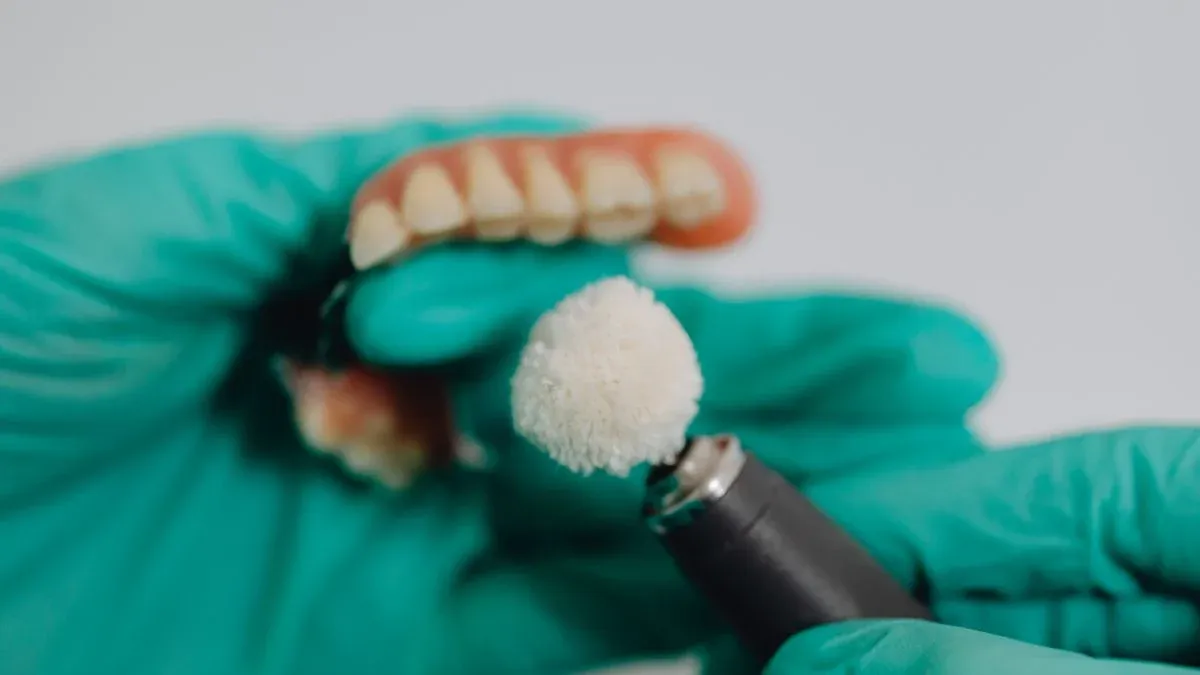
In most states, yes, but not everywhere, and rarely without conditions. At the end of 2024, 12 states didn't cover complete dentures for their main group of adult Medicaid members, according to CareQuest Institute's state survey. Relines and rebases, which keep dentures fitting as your gums change, were uncovered in 28 states.
Here's what that looks like in real state rules:
- Missouri covered complete dentures only for pregnant patients, blind patients and nursing home residents. Even then, it paid once every 15 years.
- South Carolina didn't cover dentures for adults, except those enrolled in a specific disability waiver.
- Vermont and New Hampshire rate as "enhanced" overall. Yet both covered complete dentures only for certain groups, such as people in specific waiver programs.
- Pennsylvania lists dentures among covered services for adults, alongside exams, cleanings, fillings and extractions (Pennsylvania DHS (opens in a new tab)).
- New York covers dentures and, in certain circumstances, implants. Since January 31, 2024, replacement dentures and implants no longer need a letter from your physician (New York State Department of Health (opens in a new tab)).
Even where dentures are covered, expect to need approval first, and a limit on how often they're replaced. Before a dentist starts the work, ask them to confirm the approval is on file. If Medicaid won't pay, our guide to insurance with no waiting period for dentures covers the private options.
What About Seniors on Both Medicare and Medicaid?
Medicare won't fill the gap. Medicare.gov says that in most cases Medicare doesn't cover "routine cleanings, fillings, tooth extractions (removals), or items like dentures and implants" (Medicare.gov (opens in a new tab)). For the roughly 12.9 million people enrolled in both programs in 2021, called dual-eligibles, dental coverage usually comes from two other places.
Your state's Medicaid adult dental benefit. If your state has enhanced benefits, that's often the most complete dental coverage you can get. One caveat matters here. The national benefit surveys measure coverage for adults ages 21 to 64, and states can treat older members differently. Before Utah's 2025 expansion, for example, its Medicaid covered dental care for members 65 and older but not for most younger adults. Ask your state what applies at your age.
A Dual Eligible Special Needs Plan (D-SNP). These are Medicare Advantage plans built for people on both programs, and KFF found that 95% of them offered dental benefits in 2024 (KFF (opens in a new tab)). The details vary widely, so check the annual dental limit and whether dentures are included. Our guide to finding dentists who accept Medicare Advantage dental explains how to check a plan's network.
For the Medicare side of this, see does Medicare cover dental work. If you're comparing standalone plans, our guide to the best dental insurance for seniors is the next step.
Covered on Paper vs. Finding a Dentist
A covered benefit only helps if a dentist will take it. The ADA Health Policy Institute found that about 41% of U.S. dentists participated in Medicaid or CHIP in 2024, a share that has barely moved in a decade.
That gap shows up in who actually gets care. In 2022, around one in five adult Medicaid members in enhanced-benefit states saw a dentist, compared with fewer than one in ten in emergency-only states. Better benefits help, but they don't guarantee an appointment.
So start with the provider list from your state Medicaid program or your Medicaid dental plan. Call the office, confirm they're taking new Medicaid patients, and ask how soon they can see you. If you're in a managed care plan, use that plan's directory. An office that takes "Medicaid" may not take your specific plan.
Could Your Medicaid Dental Coverage Change?
Yes, and it's worth checking every year. Because adult dental is optional, it's one of the first things states consider when budgets get tight. A Harvard-led study of low-income adults ages 50 to 64 found that when states cut adult dental benefits, the chance of a dental visit in the prior two years fell by 37 percentage points. Some effects lasted up to eight years (Commonwealth Fund, 2026 (opens in a new tab)).
The same research found that many people didn't know their coverage had changed, in either direction. That's the practical risk. You might skip care you're now entitled to, or book treatment you'll end up paying for.
Eligibility rules are changing too. Under the 2025 federal budget law, adults in the ACA Medicaid expansion group will have to meet work requirements of 80 hours a month, or qualify for an exemption, starting January 1, 2027. Their eligibility will also be checked at least every six months (KFF (opens in a new tab)). If you lose Medicaid, you lose its dental benefit with it. People 65 and older aren't in the expansion group, so these rules don't apply to them.
How to Check Your State's Medicaid Dental Benefit
You can get a firm answer from two documents and one phone call:
- Find your state Medicaid agency's dental page, or the member handbook from your Medicaid dental plan if your state uses one.
- Look for a list of covered services for adults, not just children. Note any annual dollar limit.
- Check the specific treatment you need: cleanings, fillings, root canals, crowns, extractions or dentures.
- Look for rules on prior approval and how often items can be replaced, especially dentures.
- Call member services and ask: "What does my plan cover for an adult my age, and does it need prior approval?"

For a national view, CareQuest Institute's Medicaid Adult Dental Coverage Checker (opens in a new tab) shows where each state's benefit falls. Your state's own documents are still the final word, because benefits can change between survey years.
If Your State Covers Little or Nothing
If you live in one of the 12 states with limited, emergency-only or no adult dental coverage, you still have options. Here they are, roughly from lowest to highest cost:
- Community health centers. HRSA funds about 1,400 health centers running more than 16,200 sites (HRSA (opens in a new tab)). Health centers must serve patients regardless of ability to pay and discount fees on a sliding scale based on income (HRSA (opens in a new tab)). Not every center offers dental, so ask before you book.
- Dental schools. Supervised students often treat patients for less than a private practice charges. Appointments take longer, and waitlists are common.
- A dental discount plan. It isn't insurance and won't pay a claim. You pay a reduced fee at participating dentists, with no waiting period.

If your state's Medicaid already covers the care you need, use that first. A discount plan only makes sense for treatment Medicaid won't pay for, and only if a dentist near you participates. For more low-cost routes, see our guides on how to fix your teeth with no money and what to do if you need dental work without insurance.
Frequently Asked Questions
Does Medicaid cover dental for adults in every state?
No. Adult dental is optional under federal Medicaid rules, so each state decides. In 2025, 38 states and DC offered enhanced adult benefits, six offered limited coverage, and five covered emergencies only. Alabama offered no adult dental coverage except for pregnant and postpartum adults. Children's dental care, by contrast, must be covered in every state.
Does Medicaid cover dentures for seniors?
It depends on your state. At the end of 2024, 12 states didn't cover complete dentures for most adult members, and 28 didn't cover relines or rebases. National surveys measure adults ages 21 to 64, and states can treat members 65 and older differently. Ask your state what applies at your age, and expect prior authorization and a replacement limit.
What does Medicaid cover for dental for adults?
In an enhanced-benefit state, usually exams, X-rays, cleanings and fillings, plus some combination of extractions, root canals, crowns and dentures, often with an annual limit. Limited states cover a smaller set with a cap of $1,000 or less. Emergency-only states cover pain relief, such as pulling an infected tooth.
Does Medicare cover dental if I also have Medicaid?
Original Medicare still doesn't cover routine dental care or dentures. If you have both programs, your dental coverage usually comes from your state's Medicaid adult benefit, a Dual Eligible Special Needs Plan, or both. KFF found that 95% of these plans offered dental benefits in 2024, but limits vary widely.
Why can't I find a dentist who takes Medicaid?
Only about 41% of U.S. dentists participated in Medicaid or CHIP in 2024, according to the ADA Health Policy Institute. Start with your state or plan's provider directory, call to confirm the office takes new Medicaid patients, and check community health centers and dental schools, which often accept Medicaid.
Can I lose Medicaid dental coverage?
Yes, in two ways. Your state can reduce adult dental benefits, since they're optional. You can also lose Medicaid itself. Starting January 1, 2027, adults in the ACA expansion group must meet work requirements or qualify for an exemption, and their eligibility will be reviewed at least every six months.
The Bottom Line
Does Medicaid cover dental for adults? In most states it does, but "most" isn't "all," and coverage isn't the same everywhere. In 2025, 38 states and DC offered enhanced benefits, while 12 offered limited, emergency-only or no coverage. Dentures are the service most likely to be missing, even in states with broad benefits.
Check your state's current adult benefit and the specific treatment you need. Then confirm prior approval and find a dentist who takes your plan before you start. If you're on both Medicare and Medicaid, compare your state benefit with what a D-SNP offers.
Related guides: does Medicare cover dental work, dental insurance cost for seniors, dental insurance eligibility after age 65, dental discount plan vs. insurance. More answers in our dental insurance FAQ hub.
This article is for informational purposes only and does not constitute legal, dental or financial advice. Medicaid dental benefits vary by state and change over time. Confirm your current coverage with your state Medicaid program before starting treatment.