How much does a root canal cost with insurance? A root canal runs about $900 to $1,500 before insurance, depending on the tooth. Most plans pay 50% to 80% after the deductible. On a molar at an in-network dentist, that usually leaves you owing roughly $250 to $600. The crown that often follows is a separate bill.
Three things set your real number. One is the fee your plan starts from. Another is whether it files root canals as basic or major work. The third is what’s left of your annual maximum. Below are prices by tooth, the math insurers use, and six worked examples built on real 2026 plan rules. Just want to know if your plan covers a root canal at all? Start with whether dental insurance covers root canals.
Key Takeaways
What a Root Canal Costs Without Insurance, by Tooth
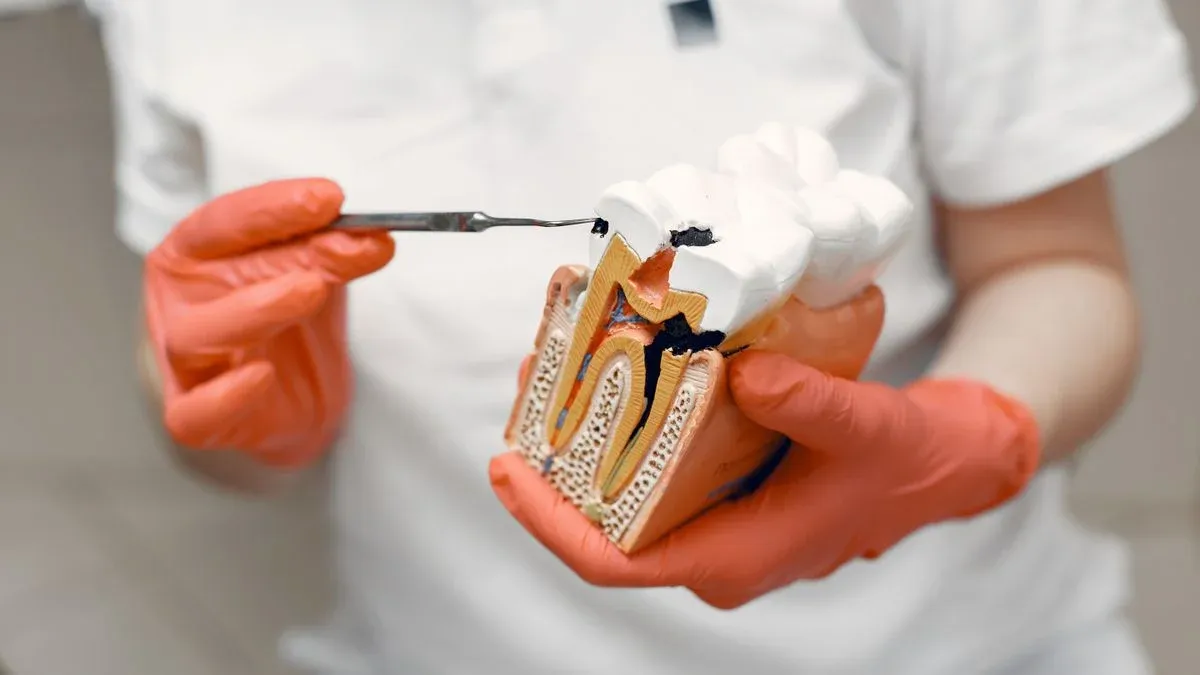
The price follows the tooth. Front teeth usually have a single canal. Molars have several that are harder to reach, so they take more time and cost more, as the American Association of Endodontists explains. Each tooth type has its own procedure code, and the table shows three published figures for each one.
| Tooth | Procedure code | National average (range) | Typical out-of-network charge | Flat copay, California copay plan |
|---|---|---|---|---|
| Front tooth (incisor or canine) | D3310 | $905 ($590 to $1,527) | About $1,200 | $200 |
| Premolar | D3320 | $1,023 ($691 to $1,827) | About $1,300 | $235 |
| Molar | D3330 | $1,220 ($833 to $2,171) | About $1,500 | $300 |
Why don't the numbers match? They measure different things. The first column is the average patients paid nationally, from the 2026 Synchrony Average Procedural Cost Study cited by CareCredit. The second is what Delta Dental says dentists typically charge outside its network, based on its 2025 internal data. The third isn't a price at all. It's what a member pays on Covered California's 2026 adult copay schedule, where the plan covers the rest.
The fee covers the whole treatment but not the tooth's final restoration. Delta Dental says it includes every appointment and X-ray needed to finish, whether that takes one visit or five. All three procedure codes carry the same note: "excluding final restoration." The filling or crown that seals the tooth afterward is a separate charge.
How Your Plan Turns a Fee Into Your Bill
Every dental claim runs through the same steps. The American Dental Association lays out the arithmetic in its guide to reading an Explanation of Benefits:
- The allowed fee. Your plan sets the most it recognizes for the procedure. An in-network dentist has agreed to accept it as payment in full.
- The deductible. You pay this first, before the plan pays toward the root canal. On the 2026 plans below, it’s $25 or $50 a year.
- Coinsurance. The plan pays its percentage of what's left, commonly 50% to 80% for a root canal.
- The annual maximum. Once the plan's payments for the year reach its cap, it stops paying and you cover the rest.
- The balance bill. Out of network, the dentist can charge you the difference between their full fee and the plan's allowed fee.
In network, the ADA's formula is simple: what the plan pays plus what you pay equals the allowed fee. Out of network, the same sum equals the dentist's full fee, and the gap lands on you. Some plans, called EPOs, pay nothing at all outside their network. That's why your dentist's network status can move the bill more than the coverage percentage does. Your deductible comes out first either way.
Whether your plan files a root canal as basic or major work sets the percentage, and plans disagree. Delta Dental's consumer guide calls root canals a major service. Kaiser Permanente's 2026 individual PPO in California lists a root canal as basic. Covered California's standard coinsurance plan puts endodontics under major services at 50%. Your own summary of benefits is the only answer that counts.
Root Canal Cost With Insurance: Six Worked Examples
The examples below all use the same molar, so you can see what changes the bill. We assume an in-network allowed fee of $1,100, a little under the $1,220 national average, because network dentists accept discounted fees. The out-of-network dentist charges $1,500, Delta Dental's typical figure. Your $50 deductible hasn't been met yet this year. Your fees will differ, but the arithmetic won't.
1. In network, root canal covered as basic at 80%
You pay the $50 deductible. The plan pays 80% of the remaining $1,050, which is $840, and your 20% share is $210. You pay $260.
2. In network, root canal covered as major at 50%
You pay the $50 deductible, then half of the remaining $1,050. You pay $575, and the plan pays $525. Same tooth, same dentist. The bill more than doubles only because of how the plan classifies the work.
3. Out of network at 50%
The plan still pays half of its $1,050 allowed amount after the deductible, which is $525. The dentist bills $1,500, so you pay $975. About $400 of that is the balance bill, the gap between the dentist's fee and the plan's allowed fee. An in-network dentist couldn't charge it.
4. A plan that pays a fixed dollar amount
Some plans skip percentages and pay from a fixed table. Kaiser Permanente's 2026 individual adult dental PPO in California pays up to $306 toward a root canal. You owe anything above that. Its $25 deductible comes out of that allowance, as the plan's own crown example shows. On a $1,100 fee, the plan pays $281. You pay $819. The same plan covers a root canal once per tooth every five years, after a six-month waiting period.
5. A flat copay plan
Copay plans, often sold as DHMOs, list a fixed charge for each procedure at their network dentists. On Covered California's 2026 adult copay schedule, a molar root canal costs $300, a premolar $235 and a front tooth $200. There's no deductible to meet first. The trade-off is a narrower choice of dentists.
6. Still inside a waiting period
If your plan makes you wait for this kind of work and you haven't cleared it, the plan pays nothing. You pay $1,100 in network or $1,500 out of network. That's the full price, on top of the premiums you've already paid.
Chart description
No insurance or waiting period, out-of-network fee: $1,500. Out of network at 50%: $975. Fixed $306 allowance plan: $819. In network at 50%: $575. Flat $300 copay plan: $300. In network at 80%: $260.
The spread is the point. The same root canal cost with insurance ranges from $260 to $975. The plan’s rules and the dentist’s network make the difference, and that’s before a crown.
Root Canal Plus Crown: When the Annual Maximum Sets the Bill
A back tooth usually needs a crown after a root canal. The AAE's post-treatment guidance says to book that appointment as soon as the root canal is finished. Your plan treats the crown as a separate procedure, usually major work. Both payments come out of the same annual maximum.
Take a plan that pays 50% on both, with a $1,000 annual maximum like Kaiser’s 2026 plan above. The root canal's allowed fee is $1,100. The crown is $1,300, the in-network total Kaiser uses in its own crown example.
| Step | Root canal | Crown | Total |
|---|---|---|---|
| Allowed fee | $1,100 | $1,300 | $2,400 |
| Deductible you pay first | $50 | $0 | $50 |
| Plan's 50% share | $525 | $650 | $1,175 |
| Plan actually pays (capped) | $1,000 | ||
| You pay | $1,400 |
Without the cap, the plan would pay $1,175 and you'd owe $1,225, so the $1,000 maximum costs you another $175. On a plan with a $1,500 maximum, like Covered California's standard coinsurance plan, the full $1,175 fits and you'd pay $1,225. If you've already used part of this year's maximum on fillings or another tooth, the gap grows.
A common tip is to split the work across two plan years: root canal in December, crown in January. That works when the timing falls that way on its own. Don't stretch the gap to game the calendar, though. The AAE advises against biting down hard on the tooth until it’s restored. The crown shouldn’t wait for your benefits to reset. For crown coverage rules in detail, see does dental insurance cover crowns.
Why Your Quote Is Higher Than These Numbers
If your dentist quoted $3,000, the quote almost certainly bundles more than the root canal itself. These are the usual extras:
- The crown. Kaiser's 2026 plan example prices one at $1,300 in network and $1,750 out of network.
- A core buildup (D2950). It rebuilds the tooth so the crown has something to hold, and it appears as its own line on the claim.
- A complex tooth. Curved, narrow or extra canals, severe infection and retreatment all take more time and technique, according to the AAE. These cases are often referred to an endodontist, so confirm that the specialist is in your network too.
- Retreatment. Redoing an old root canal is billed under its own codes. On Covered California's copay schedule, molar retreatment is $350, compared with $300 for a first root canal. Some plans also limit root canals to once per tooth over a set period, five years in Kaiser's case.
- Where you live. The AAE notes that fees run higher in cities and high-cost areas.
A molar root canal at the $1,220 national average plus a $1,300 crown already comes to $2,520. Add a buildup or an exam, and a $3,000 total isn’t unusual. Ask the office for the itemized procedure codes. It's the only way to compare quotes or check your plan's math.
Waiting Periods and Other Rules That Change the Bill
Waiting periods are the most common reason a covered root canal still costs full price. Delta Dental says plans that cover root canals usually make you wait 6 to 12 months for major services. Kaiser's 2026 individual plan waits six months for endodontics.
Prior coverage can remove the wait. Covered California’s standard dental plans must waive the six-month major-services wait if you prove prior comparable coverage. It also states that a dental discount plan doesn't count as comparable coverage. Other insurers set their own rules, so ask before you switch. Our dental insurance waiting period guide covers the details. Our list of plans with no waiting period shows options that pay sooner.
Before treatment, ask your dentist to submit a pre-treatment estimate. The insurer reviews the planned work and tells you what it expects to pay, as Northeast Delta Dental's glossary describes. It's the most reliable number you'll get before the bill. The AAE also notes that some plans require pre-authorization before a root canal.
Root Canal or Extraction: Which Costs Less?
Pulling the tooth is cheaper on the day. It rarely stays that way. On Covered California's 2026 adult copay schedule, a simple extraction is $65. A molar root canal is $300, and a crown is another $300. The same schedule doesn't cover implant placement for adults, though. A missing tooth leaves a gap that neighboring teeth can drift into. Filling it with a bridge or implant is where extraction gets expensive.
The American Association of Endodontists puts it plainly: "more often than not, opting for a root canal will be less expensive and allow you to keep your tooth." If extraction turns out to be your only option, check how plans handle dental implant coverage before you choose a replacement.
If You Don't Have Insurance, or You're Still Waiting
Buying a plan today won’t pay for a root canal you need next week. Most plans put a waiting period on this kind of work. These options can help now:
- Ask for the cash price. The national range for a molar runs from $833 to $2,171, so calling two or three offices is worth the time.
- Use an HSA or FSA. The IRS counts treatment to alleviate dental disease as a medical expense.
- Try dental schools and community clinics. See our guides to fixing your teeth with no money and what to do when you need dental work without insurance.
- Consider a dental discount plan. It isn't insurance. You pay a membership fee and get reduced prices at participating dentists, usually with no waiting period. You still pay the discounted price yourself, so confirm your dentist participates and ask for the root canal price before you join. Our comparison of a dental discount plan vs insurance explains the trade-offs.
Frequently Asked Questions
How much does a root canal cost with insurance?
A root canal costs about $900 to $1,500 before insurance. Most plans pay 50% to 80% after the deductible, which typically leaves you paying roughly $250 to $600 on a molar at an in-network dentist. Fixed-copay plans can cost less, such as $300 for a molar on Covered California's 2026 adult copay plan.
How much does a molar root canal cost with insurance?
Take a $1,100 in-network fee and a $50 deductible. You’d pay about $260 if your plan covers the root canal at 80%, or $575 at 50%. Out of network, where the dentist can bill above the plan's allowed fee, the same tooth could cost you around $975.
Why is my root canal quote $3,000?
A quote that high usually includes the crown, a core buildup and possibly a specialist's fee on top of the root canal. A $1,220 molar root canal plus a $1,300 crown already comes to $2,520. Ask the office for the itemized procedure codes.
Does insurance cover a root canal and a crown in the same year?
Usually, yes, as two separate procedures that both draw from your annual maximum. With 50% coverage and a $1,000 maximum, a $1,100 root canal plus a $1,300 crown can leave you paying $1,400.
Is it cheaper to pull a tooth than to get a root canal?
On the day, yes. Over time, usually not, because the gap from a missing tooth often needs a bridge or implant. The American Association of Endodontists says a root canal is, more often than not, the less expensive choice.
What can I do if I can't afford a root canal?
Ask several offices for a cash price, use HSA or FSA funds, and check dental schools and community clinics. A dental discount plan can lower the price with no waiting period, but it isn't insurance. Ask your dentist which treatment can't wait.
Bottom Line
The root canal cost with insurance you actually pay depends less on the brochure percentage than on four things. They are the fee your plan allows, whether it calls the work basic or major, your dentist’s network, and what’s left of your annual maximum after the crown. Get a pre-treatment estimate, ask for the procedure codes, and run the numbers before you schedule. For the coverage side of the question, see does dental insurance cover root canals, and for more procedure prices, browse our dental cost guides.
This article is for informational purposes only and does not replace advice from a licensed dentist, insurance provider, or benefits administrator. Coverage, costs, and eligibility vary by plan, provider, location, and policy terms.
Sources and References
- Delta Dental: How much does a root canal treatment cost? (July 2026)
- Delta Dental: Dental Insurance for Root Canals (April 2026)
- CareCredit: Root Canal Cost and Procedure Guide (2026 Synchrony Average Procedural Cost Study)
- Covered California: 2026 Dental Copay Schedule
- Covered California: 2026 Dental Benefit Plan Designs
- Kaiser Permanente Insurance Company: Individual Adult Dental Plan, Summary of Dental Benefits 2026
- American Dental Association: Explanation of Benefits Statement
- Northeast Delta Dental: Some Words You Need to Know
- American Association of Endodontists: How Much Does a Root Canal Cost?
- American Association of Endodontists: Root Canal vs Extraction
- American Association of Endodontists: Post-Treatment Care
- IRS Publication 502: Medical and Dental Expenses