Does dental insurance cover deep cleaning? Usually, yes, but not like a regular cleaning. A deep cleaning (scaling and root planing) is billed as gum disease treatment, one quarter of your mouth at a time. Plans pay a share after the deductible, usually only when your exam shows gum pockets of 4 mm or more with bone loss on X-rays.
Without insurance, it averages $242 per quarter of the mouth, or about $968 for all four. Once coverage is in effect, the 2026 examples below range from $0 to $425. The real surprises come later, with the follow-up cleanings. Here's how the codes, the rules and the math work.
Key Takeaways
Deep Cleaning vs. a Regular Cleaning: Four Codes, Four Price Tags
Your dentist reports every cleaning with a procedure code, and your plan pays by the code, not by the name on your bill. The CDC reports that about 4 in 10 U.S. adults age 30 or older had some level of periodontitis in 2009 to 2014, and about 60% of adults 65 or older. It also names the standard treatment as "scaling and root planing" or "deep cleaning."
| Code | What it is | How plans usually treat it | Covered California 2026 adult copay |
|---|---|---|---|
| D1110 | Regular cleaning for healthy gums | Preventive, often no charge | No charge |
| D4346 | Full-mouth scaling for heavy gum inflammation with no bone loss | Varies: preventive on some plans, a separate service on others | $40 |
| D4341 / D4342 | Deep cleaning (scaling and root planing): 4 or more teeth, or 1 to 3 teeth, in one quadrant | Periodontal treatment, often basic, once per quadrant every 24 months | $55 / $25 per quadrant |
| D4910 | Periodontal maintenance, the follow-up cleaning after gum treatment | Periodontal service, often limited to a set number of visits per year | $30 |
A regular cleaning removes plaque and tartar above and just below the gumline on healthy teeth. A deep cleaning, however, goes onto the root surfaces inside the pocket. Aetna's clinical policy describes it as "therapeutic, not prophylactic," meaning it treats disease instead of preventing it. It usually takes numbing and more than one visit. Aetna notes the usual maximum is two quadrants per appointment.
D4346 sits in between. It's for gums that are swollen and bleeding across more than half the mouth, but with no bone loss yet. Aetna is clear that it isn't simply a harder regular cleaning. On Aetna's 2026 federal dental plan, D4346 is listed under preventive services, while deep cleaning is a Class B service with coinsurance.
What a Deep Cleaning Costs Without Insurance
The copays in the table come from Covered California's 2026 copay schedule, where you pay a set amount and the plan covers the rest. Without insurance, CareCredit cites a 2024 Synchrony fee study: $242 per quadrant on average, with a range of $185 to $444. In contrast, a routine cleaning averages $203 in the same study.
When Will Insurance Cover Deep Cleaning?
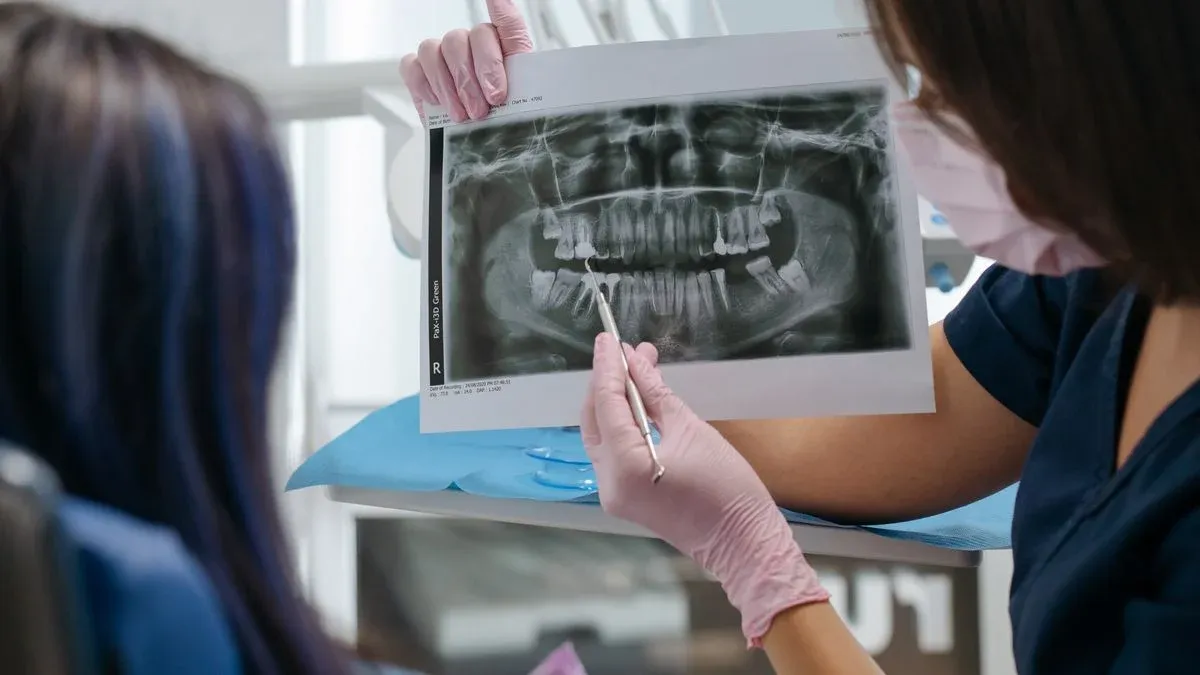
Insurers that publish their rules pay for a deep cleaning only when your records show gum disease that has reached the bone. Cigna is one of them. Under its 2026 dental PPO coverage guidelines, a deep cleaning is allowed when charting and X-rays show:
- Gum pockets of 4 mm or deeper on the teeth being treated. D4341 needs four or more such teeth in the quadrant; D4342 covers one to three.
- Bone loss visible on X-rays. Deep pockets alone aren't enough.
Aetna asks dentists to keep the evidence on file: a full-mouth chart with six depth readings per tooth, bleeding points, full-mouth X-rays, and notes on how long the visit took and what numbing was used. In addition, the records must show lost gum attachment, bone loss and tartar on the roots.
That's why claims get denied. For example, without bone loss, Cigna's rules don't allow the deep cleaning code at all. Heavy inflammation with no bone loss fits D4346 instead. Cigna also won't pay for a deep cleaning on the same day as periodontal maintenance.
One rule protects you. If the same Cigna network office repeats a deep cleaning on the same quadrant within 24 months, Cigna doesn't pay. Its guidelines say the patient is not responsible for that charge either. Other plans also set the same 24-month limit. Kaiser Permanente's 2026 individual PPO in California and Aetna's 2026 federal dental plan both cover it once per quadrant every 24 months.
Before you book, ask the office for a pre-treatment estimate. The insurer then reviews the chart and X-rays and tells you what it expects to pay.
Deep Cleaning Cost With Insurance: Worked Examples
Each example is a full-mouth deep cleaning, four quadrants of D4341. We assume an in-network allowed fee of $200 per quadrant, or $800 total. That's a little under the $242 national average, because network dentists accept discounted fees. We also assume your $50 deductible hasn't been met yet where the plan has one. Your fees will differ, but the arithmetic won't. It's the same fee-to-bill math plans use for a root canal.
1. Covered California standard coinsurance plan
The 2026 standard adult plan lists periodontics as a basic service, so you pay 20% in network after a $50 deductible. First comes the $50 deductible, and then 20% of the remaining $750. You pay $200.
2. Covered California copay plan
A flat $55 per quadrant, with no deductible. You pay $220. If only one to three teeth in a quadrant need it, that quadrant is $25.
3. Aetna federal dental plan (FEDVIP), High and Standard options
Deep cleaning is a Class B service. On the High option you pay 30% with no deductible: $240. On the Standard option you pay a $50 deductible, then 45%: $387.50. The brochure doesn't publish its allowed fee, so we use the same $800. In addition, neither option has a waiting period.
4. A plan that pays 50%
Some plans pay half. For instance, CareCredit says insurance usually covers around 50% of a deep cleaning. You pay the $50 deductible, then half of $750. You pay $425.
5. Out of network at 80%
The plan pays 80% of its allowed fee after the deductible, which is $600. Assume the plan allows the same $800 here, while the dentist charges the $968 national average. You pay $368. About $168 of that is the balance bill, the gap an in-network dentist couldn't charge you.
6. Still inside a waiting period
For example, Kaiser's 2026 individual plan makes you wait six months for periodontics. Until then, the plan pays nothing. You pay $800 in network, or the dentist's full fee out of network.
7. Delta Dental SmileWay, for some chronic conditions
Some employer plans pay in full. Delta Dental's SmileWay Wellness Benefits covers one deep cleaning per quadrant at 100%. However, it's only for members diagnosed with any of 14 conditions, including diabetes, heart disease, cancer and stroke. It's an add-on to Delta Dental PPO group plans and comes included on most small business plans. Still, you have to opt in through your Delta Dental account. You pay $0.
Chart description
No insurance at the national average: $968. Inside a waiting period: $800. Plan pays 50%: $425. Aetna FEDVIP Standard: $387.50. Out of network at 80%: $368. Aetna FEDVIP High: $240. Covered California copay plan: $220. Covered California coinsurance plan: $200. Delta Dental SmileWay add-on: $0.
Overall, the spread runs from $0 to $968 for the same treatment. The whole difference comes from the plan: how it classifies gum treatment, whether your dentist is in its network, and whether you're past its waiting period.
After the Deep Cleaning: Periodontal Maintenance and Its Limits
This is where coverage gets tighter. The ADA says periodontal maintenance claims are often denied because of plan limits. Once you've had a deep cleaning, your regular cleanings usually stop being regular cleanings. Instead, your dentist reports them as periodontal maintenance (D4910). It's a more involved visit, and it continues at intervals your dentist sets, for as long as you have the teeth. Cigna's guidelines say only that the interval is "determined by the clinical evaluation by the dentist."
Plans limit it in different ways:
- A yearly count. Aetna's 2026 federal plan pays periodontal maintenance twice per calendar year. Kaiser's 2026 individual plan allows two cleanings a year. It covers a cleaning after gum therapy once a 30-day healing period has passed.
- A time window. The American Dental Association reports that some insurers pay for it only within 2 to 12 months of the deep cleaning. Some want treatment on at least two quadrants first, and most require 8 to 12 weeks to pass after it.
- A downgrade. When a plan's limit is used up, the ADA says many insurers pay the visit as a regular adult cleaning instead. You pay the rest of the fee.
So if your dentist recommends more maintenance visits a year than your plan pays for, the extra visits come out of your pocket. Ask two questions before your first maintenance visit: how many D4910 visits does my plan cover per year, and do they share a limit with regular cleanings? If you've switched insurers, ask your dentist to send your gum treatment history with the first claim. The ADA notes that a new insurer may not know you've had treatment.
On a copay plan, the math is simpler. Covered California's 2026 adult copay for periodontal maintenance is $30 a visit.
Waiting Periods, Annual Maximums and Timing
Whether you wait depends on how your plan files gum treatment. Kaiser's 2026 individual PPO, for instance, puts a six-month wait on periodontics. Covered California's standard plans apply their six-month wait only to major services, and periodontics is basic there, so no wait applies. Aetna's 2026 federal plan, on the other hand, has no waiting periods at all. Our dental insurance waiting period guide explains how to check yours.
The annual maximum rarely blocks a deep cleaning on its own. At an $800 allowed fee, a plan paying 80% spends $600 of its yearly cap. It matters when the same year also brings a crown, a root canal or gum surgery. That's because every payment comes out of the same cap. Your deductible still comes first.
Because deep cleanings are usually done two quadrants at a time, some patients split the work across two plan years. That only helps if both visits were going to fall close to the turn of the year anyway. Gum disease shouldn't wait for your benefits to reset, so ask your dentist how soon each side needs treatment.
Does Medicare Pay for a Deep Cleaning?
In most cases, no. Medicare says it doesn't cover dental services like routine cleanings, fillings or extractions. It covers some dental care only when it's directly linked to a covered medical treatment. Examples include dental treatment before a heart valve replacement or an organ transplant, or treating a mouth infection before cancer treatment. Otherwise, Original Medicare won't pay for a deep cleaning.
If You Don't Have Coverage, or You're Still Waiting
A plan you buy today may not pay for a deep cleaning right away, and some plans put gum treatment behind a waiting period. Meanwhile, these options can help now:
- Ask for the cash price per quadrant. The national range runs from $185 to $444 per quadrant, so comparing two or three offices can save real money.
- Use an HSA or FSA. The IRS counts treatment to alleviate dental disease as a medical expense.
- Try dental schools and community clinics. See our guide to fixing your teeth with no money.
- Consider a dental discount plan. It isn't insurance. You pay a membership fee and get reduced prices at participating dentists, usually with no waiting period. You still pay the discounted price yourself. On some plans, specialists such as periodontists take a flat percentage off their own fees instead. Ask before you book. Our comparison of a dental discount plan vs insurance explains the trade-offs.
Frequently Asked Questions
Does dental insurance cover deep cleaning?
Usually, yes, when your records show gum disease. Cigna, for example, wants gum pockets of 4 mm or deeper and bone loss on X-rays. Plans pay a share after the deductible. On the 2026 plans in this guide, your share ranged from 20% to 45%, or a flat $55 per quadrant on a copay plan.
How much is a deep cleaning with insurance?
With an $800 in-network fee for all four quadrants and a $50 deductible, you'd pay about $200 if your plan covers 80%, or $425 at 50%. Without insurance, the national average is $242 per quadrant, about $968 for the full mouth.
What qualifies you for a deep cleaning?
Gum pockets of 4 mm or deeper along with bone loss visible on X-rays, according to Cigna's 2026 guidelines. Heavy gum inflammation without bone loss is billed under a different full-mouth cleaning code (D4346), not as a deep cleaning.
How often will insurance cover deep cleaning?
Usually once per quadrant every 24 months. Kaiser Permanente's 2026 California individual plan and Aetna's 2026 federal dental plan both set that limit. Cigna won't pay for a repeat on the same quadrant by the same network office within 24 months. It says the patient isn't responsible for that charge.
Is periodontal maintenance covered by insurance?
Usually, but with limits. Aetna's 2026 federal plan, for example, covers two visits a year. Some cover it only for a set period after the deep cleaning, and some pay it as a regular cleaning once the limit is used. Ask how many maintenance visits your plan pays for each year.
Why was my deep cleaning claim denied?
Common reasons include missing proof of bone loss, pockets under 4 mm, a waiting period that hasn't ended, or a repeat within 24 months. Ask the office which records were sent, and request a pre-treatment estimate before the next visit.
Bottom Line
The plans we checked pay for a deep cleaning when your chart and X-rays prove gum disease, usually as a basic service you share with the plan. What you pay depends on four things: the per-quadrant fee, how your plan classifies gum treatment, any waiting period, and the limits on the maintenance visits that follow. Get a pre-treatment estimate and ask for the procedure codes before you book. For what dental plans cover more broadly, see what dental insurance covers, and for more procedure prices, browse our dental cost guides.
This article is for informational purposes only and does not replace advice from a licensed dentist, insurance provider, or benefits administrator. Coverage, costs, and eligibility vary by plan, provider, location, and policy terms.
Sources and References
- CDC: About Gum (Periodontal) Disease
- Cigna Healthcare: Dental Clinical Coverage Determination Guidelines, DPPO (2026)
- Aetna: Dental Clinical Policy Bulletin 041, Scaling and Root Planing
- Aetna: Dental Clinical Policy Bulletin 042, Scaling in Presence of Generalized Gingival Inflammation
- U.S. Office of Personnel Management: Aetna Dental FEDVIP 2026 Brochure
- Covered California: 2026 Dental Copay Schedule
- Covered California: 2026 Dental Benefit Plan Designs
- Kaiser Permanente Insurance Company: Individual Adult Dental Plan, Summary of Dental Benefits 2026
- American Dental Association: D4910 Coding for Periodontal Maintenance
- Delta Dental: Expanded Coverage for Chronic Conditions (updated April 2026)
- CareCredit: Scaling and Root Planing Cost (2024 Synchrony Average Procedural Cost Study)
- Medicare.gov: Dental Services
- IRS Publication 502: Medical and Dental Expenses