
How much does a crown cost with insurance? Once any waiting period is over, most plans that cover crowns pay half of their allowed fee, so you pay the other half. On a $700 in-network fee, that's $350. During the waiting period you pay the whole in-network fee yourself, and on a plan that doesn't cover major work you can owe the full price, which averages $1,399 for a porcelain crown. We checked all 652 dental plans sold on HealthCare.gov for 2027 to show what each one leaves you to pay.
Key Takeaways
How Much Does a Crown Cost With Insurance?
The short answer: you pay a share of the plan's allowed fee, not of your dentist's full price. A crown is "major" work on almost every plan, and the most common split is 50/50. However, the share differs a lot from plan to plan. Here's what you'd pay on one crown under the 2027 HealthCare.gov plans, after the waiting period and the deductible.
| Your share on the plan | Plans in the 2027 files | You pay on a $700 fee | You pay on a $1,399 fee |
|---|---|---|---|
| 41% to 50% | 308 | $287 to $350 | $574 to $700 |
| 60% | 30 | $420 | $839 |
| 70% | 41 | $490 | $979 |
| 75% | 22 | $525 | $1,049 |
| 85% | 8 | $595 | $1,189 |
| Flat copay | 33 | $197 to $400 (median $250) | |
| Plan pays nothing for adult crowns | 210 | $700 | $1,399 |
The $700 column uses the in-network fee from Delta Dental's own crown example. The $1,399 column uses the national average price of a porcelain crown, which is roughly what you face when no network discount applies. Among plans that pay a percentage, none pays more than 59% of the fee.
Source: our analysis of the CMS 2027 Exchange plan and benefit files (652 adult stand-alone dental plans with a valid rate, 29 HealthCare.gov states).
Chart description
Of 652 adult dental plans in the 2027 HealthCare.gov files, 308 leave you 41% to 50% of the crown fee, 93 leave you 60% to 75%, 8 leave you 85%, 33 charge a flat copay of $197 to $400, and 210 pay nothing toward adult crowns.
What a Crown Costs Before Insurance
Before insurance, a crown usually costs $700 to $1,400 on average, depending on the material. Those averages come from a 2024 national price survey by ASQ360° for CareCredit, and they don't include the exam, X-rays or any extraction.
| Type of crown | National average | Typical range |
|---|---|---|
| Porcelain | $1,399 | $915 to $3,254 |
| Metallic | $1,211 | $821 to $2,861 |
| Porcelain and metal (non-gold) | $1,114 | $770 to $2,454 |
| Resin or temporary | $697 | $488 to $1,593 |
Where you live moves the price a lot. In the same survey, a porcelain crown averages $1,046 in Alabama, $1,372 in Florida, $2,296 in Hawaii and $2,331 in California. For the full picture of what dental work costs without a plan, see our guide to the most expensive dental services without insurance.
What 2027 Dental Plans Pay Toward a Crown
We read the CMS plan and benefit files for every adult stand-alone dental plan sold on HealthCare.gov for 2027. Crowns fall under "Major Dental Care" in those files. Here's what the 652 plans with a valid premium do with that category:
- 409 plans pay a percentage. You pay 50% on 306 of them. The rest leave you more: 60% on 30 plans, 70% on 41, 75% on 22 and 85% on 8. Only 2 plans leave you less than half (41% and 43%).
- 33 plans charge a flat copay. The copay for a crown runs from $197 to $400, with a median of $250. On 18 of them, the copay applies only at the plan's dentists, and out of network the plan pays nothing.
- 210 plans pay nothing. They either list adult major care as not covered or leave you 100% of the fee. Coverage for crowns shows up in the price: the median plan that pays toward major work costs $28.55 a month at age 40, against $23.53 for all plans. So check the major care line before you pick the cheapest premium.
The files don't show each plan's adult deductible or yearly maximum, so the figures above leave those out. You'll see how both change the bill in the worked example below. Our guides to the dental deductible and the annual maximum explain both.
The Waiting Period Decides What You Pay This Year
If you buy a plan because you need a crown now, the waiting period matters more than the percentage. Among the 442 plans that pay toward crowns, 362 make adults wait 12 months or more. Here's the full count:
| Wait before the plan pays for a crown | Plans |
|---|---|
| None | 35 |
| 6 to 9 months | 36 |
| 12 months | 334 |
| 15 or 18 months | 28 |
| Not clearly stated in the file | 9 |
During the wait, the plan pays nothing toward the crown, so the whole fee is yours. If your dentist is in the network, it's still the in-network fee: the American Dental Association explains (opens in a new tab) that work a plan covers but won't pay for yet stays at the PPO fee. Plans that pay from day one usually pay less: of the 35, 14 leave you 75% or 85% of the fee, 16 charge a flat copay of $200 to $400, and only 5 leave you about half. Our waiting period guide covers the rules, and our list of plans with no waiting period shows what they pay.
Why the Dentist's Network Changes Your Cost
An allowed fee is the price your plan has agreed with in-network dentists, and your plan pays its share of that fee. Out of network, the dentist can bill you for the gap between their price and that allowed fee. Delta Dental shows this with a $1,400 crown on one of its PPO plans:
| Where you go | Allowed fee | Plan pays | You pay |
|---|---|---|---|
| Delta Dental PPO dentist | $700 | $630 (90%) | $70 |
| Delta Dental Premier dentist | $900 | $720 (80%) | $180 |
| Out-of-network dentist | $700 | $350 (50%) | $1,050 |
That plan pays more than most, so the percentages are higher than you'll usually see. Still, the lesson holds for any plan: the same crown cost $70 or $1,050 depending only on the dentist. Our guide to in-network vs. out-of-network dentists explains balance billing in detail.
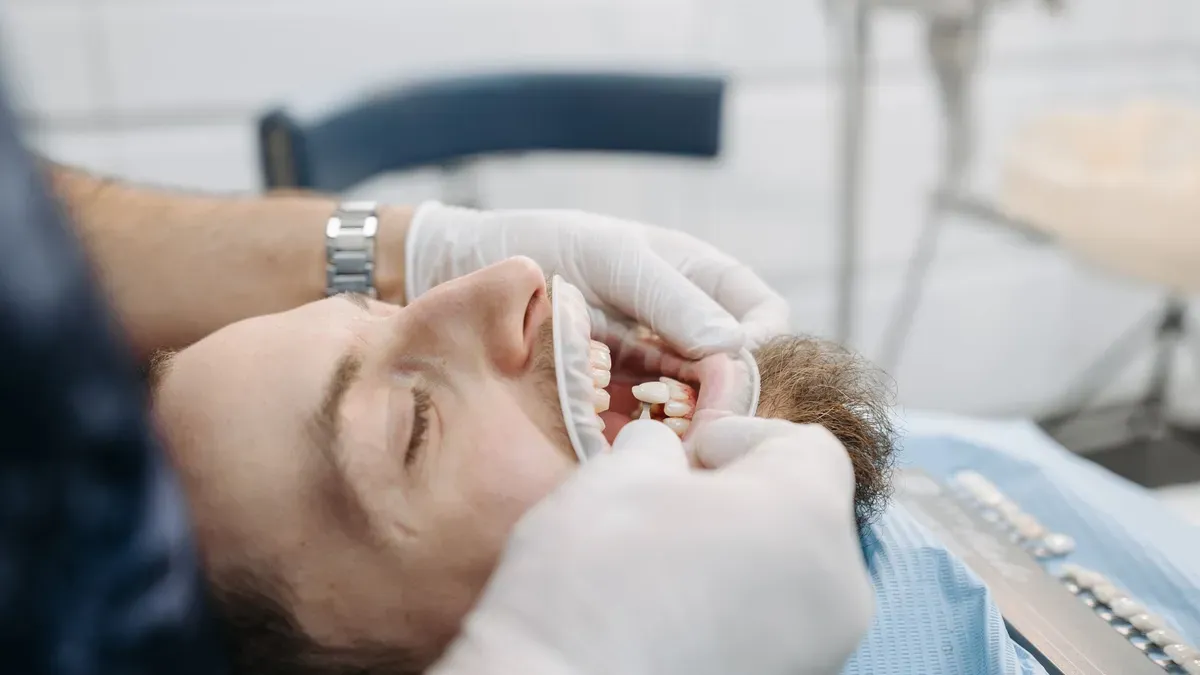
On a back tooth, some plans pay only for a metal crown, even if you choose a tooth-colored one.
Porcelain on a Molar: The Clause That Costs Extra
Many plans pay for the least costly treatment that would work, not for the one you choose. On a back tooth, that can mean the plan pays as if you'd gotten a metal crown, and you owe the difference for porcelain. Here's how four 2027 plan documents put it:
- Cigna Dental Family + Pediatric plans (Arizona, Florida, Tennessee and Texas): for adults, benefits "are based on the amount payable for non-precious metals," with "no porcelain or white/tooth-colored material on molar crowns."
- Delta Dental of Nebraska's Gold plan pays "only for the applicable percentage of the least costly commonly performed course of treatment," and you pay the balance.
- AARP Dental Insurance from Delta Dental (Florida): if a tooth can be fixed with a filling but you choose a crown, the plan pays only the share of "the least costly Restorative procedure."
- MetLife's federal dental plan warns that when it pays for a less costly service, the dentist may charge you the difference "even if the service is performed by an In-Network dentist."
So, before you agree to a porcelain or zirconia crown on a molar, ask the office which crown your plan will pay for, and what the difference will be.
How Often Insurance Pays for a Crown on the Same Tooth
Plans limit how often they replace a crown. Delta Dental of Nebraska's Gold plan covers a crown once per tooth every 5 years, and AARP's plan from Delta Dental has the same 5-year rule. Cigna's 2027 family plans go further for adults: once per tooth every 84 months, and only when major decay makes a new crown necessary. If your crown is younger than that, the plan pays nothing toward a replacement.
A Worked Example: Root Canal and Two Crowns on One Plan
The yearly maximum is where a crown gets expensive. Let's take a real 2027 design: Cigna's plan in Florida and Texas has a $50 deductible, a $1,000 yearly maximum, a 12-month wait for major work, and pays 50% for root canals and crowns. Assume the waiting period is over, your dentist is in network, and the in-network fees are $1,000 for a molar root canal and $700 for each crown. Those two fees are illustrative.
| Treatment | Fee | Plan pays | You pay | Maximum left |
|---|---|---|---|---|
| Molar root canal (after the $50 deductible) | $1,000 | $475 | $525 | $525 |
| Crown on that tooth | $700 | $350 | $350 | $175 |
| Second crown, same year | $700 | $175 | $525 | $0 |
| Total | $2,400 | $1,000 | $1,400 |
The first crown costs you $350, as expected. The second costs $525, because the maximum runs out. If the second crown can wait until the new plan year, the plan pays again after a new $50 deductible: $325, so you pay $375 and save $150. For more on this pairing, see what a root canal costs with insurance.

Ask for a pre-treatment estimate before you sign off on a crown.
How to Pay Less for a Crown
- Get a pre-treatment estimate. Your dentist sends the treatment plan to the insurer before the work starts, and you see the allowed fee, your share and any cheaper-material rule. MetLife, for example, recommends one for any service expected to cost at least $300.
- Stay in network. In Delta Dental's example, that alone was the difference between $70 and $1,050.
- Check the dates. Find out when your waiting period ends and when your plan year resets. Splitting work across two plan years can give you two yearly maximums.
- Ask about the material. On a molar, a metal crown may be fully within your benefit, while a tooth-colored one may not.
- Compare the major care line, not just the premium. A plan that pays nothing for crowns can cost you the full $1,399. Our guide to calculating what a dental plan really costs walks through the math.
If you're still choosing whether a crown is covered at all on your plan, our page on whether dental insurance covers crowns covers the rules, exclusions and missing-tooth clauses. And if you don't have a plan yet, compare a discount plan with dental insurance for your timing.
Frequently Asked Questions
Does dental insurance ever pay 100% of a crown?
Not on any plan in the 2027 HealthCare.gov files. Plans that pay a percentage leave you at least 41% of the fee, and most leave you 50%. Copay plans charge $197 to $400 per crown. Some employer plans pay more, so check your own plan's major care line.
How much does a crown cost with Delta Dental?
It depends on the plan and the network. In Delta Dental's own example, a $1,400 crown cost $70 with a PPO dentist, $180 with a Premier dentist and $1,050 out of network, on a plan that pays 90% in its PPO network. In the 2027 HealthCare.gov files, 47 of the 55 Delta Dental plans that pay toward crowns leave you 50%, and 40 of the 55 make adults wait 12 months.
Will insurance pay for a crown after a root canal?
Usually, yes. Most plans treat both as major work, so both use the same percentage and the same yearly maximum. As the worked example shows, a root canal and two crowns can use up a $1,000 maximum in one year.
Is $2,000 a lot for a dental crown?
It's above the national average of $1,399 for a porcelain crown, but within the typical range of $915 to $3,254. In California, the average is $2,331, and in Hawaii it's $2,296. With insurance, ask for the plan's allowed fee, because that's what your share is based on.
Can I get a crown covered without a waiting period?
Yes, but it usually costs more per crown. Only 35 of the 442 plans that pay toward crowns in the 2027 files pay from day one. On 14 of them you pay 75% or 85% of the fee, and 16 charge a flat copay of $200 to $400.
The Bottom Line
With insurance, a crown usually costs you about half of the plan's allowed fee: around $350 at an in-network dentist on a $700 fee. That holds only after the waiting period, inside the yearly maximum, and when the plan pays for the material you choose. In the 2027 HealthCare.gov files, a third of plans pay nothing for crowns, and most of the rest make you wait a year. Before you buy a plan for a crown, check the major care line, the waiting period and the yearly maximum. Before you book the crown, get a pre-treatment estimate.
Sources
- Centers for Medicare & Medicaid Services, Health Insurance Exchange Public Use Files, plan year 2027 (opens in a new tab) (plan attributes, benefits and cost sharing, rates). Our analysis of 652 adult stand-alone dental plans.
- Delta Dental, Why choose a PPO dentist (opens in a new tab) (crown example, 11/25).
- American Dental Association, Dear ADA: noncovered services (opens in a new tab) (ADA News, March 2026).
- CareCredit, How much do dental crowns cost? (opens in a new tab) (ASQ360° research, 2024).
- Cigna Healthcare, 2027 Dental Family + Pediatric plans, summary of benefits (opens in a new tab).
- Delta Dental of Nebraska, 2027 individual and family Gold plan booklet (opens in a new tab).
- Delta Dental, AARP Dental Insurance Plan (opens in a new tab) (Florida services, limitations and exclusions).
- MetLife, FEDVIP dental plan details and 2027 brochure (opens in a new tab).